



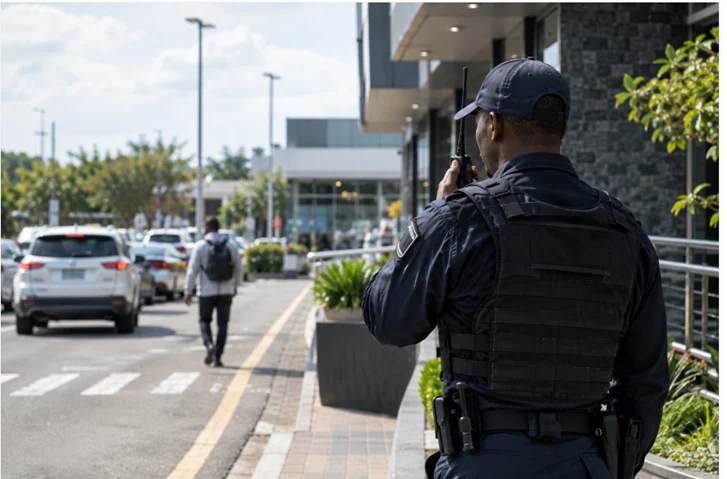
South Africans may feel safer once the sun comes up, but new crime intelligence from Durban suggests local criminals are operating on a very different clock.
Statistics South Africa’s recent 2025/2026 Governance, Public Safety and Justice Survey found that 80.7% of people feel safe walking alone in their neighbourhood during the day, compared with just 37.9% after dark. However, Blue Security’s August 2026 Crime Trends Report recorded more criminal activity during daylight hours than at night, with the morning emerging as the busiest period of all.
Of the 468 cases recorded by Blue Security across the Durban area throughout the month, 264 occurred during the day compared with 204 at night. The busiest six-hour window was 6am to midday, accounting for as many as 147 incidents.
Blue Security CEO Henk van Bemmelen says the figures challenge one of the most common myths about personal and property security – namely that the greatest danger begins after sunset.
“Crime does not operate according to the clock we may instinctively expect. Criminals are simply looking for an opportunity to exploit, which often arises while people are leaving for work, doing the school run, opening businesses, or moving through busy public spaces, with their attention elsewhere.
“Mornings can be an extremely attractive time for criminals to make a move, because a property can become vulnerable within minutes of its occupants leaving, and busy streets with increased vehicle or pedestrian movement can give offenders a degree of anonymity. Daylight should never be confused with an absence of risk.”
Crime patterns can change quickly
The report emphasised, however, that August presented a sharp reversal in the day-versus-night pattern from July, when Blue recorded 193 daytime incidents and 232 at night. This demonstrates how swiftly the periods of greatest risk can change and why vigilance should not be limited to particular hours.
With crime trends capable of shifting significantly from one month to the next, identifying those changes has become a vital part of private security. “There will always be a reactive side to security. When an alarm activates or somebody is in danger, you need people who can respond quickly. But intelligence-gathering allows us to become more proactive as well,” van Bemmelen notes.
“Every incident gives us another piece of information. By analysing when and where crimes occur, vehicle movements, camera footage, and similarities between incidents, we can spot patterns earlier and use that intelligence to guide how and where we deploy our resources. The aim is to improve our chances of disrupting criminal activity before the same offenders move on to their next target.”
Putting crime intelligence to work
During August, Blue Security received over 153,000 signals, processed more than 9.8 million vehicle reads through its SNIPR automatic number plate recognition system, and its teams patrolled close to 728,000 kilometres across its operational footprint. The company also participated in 14 joint crime-fighting operations. More broadly, the company uses information from its Crime Map, surveillance network, community reports, and vehicle intelligence to help identify suspicious activity and link incidents that may otherwise appear unrelated.
Its dedicated Investigation Unit draws on this intelligence to examine serious incidents, identify connections between cases, and support investigations alongside the South African Police Service (SAPS).
“This is particularly critical when dealing with organised groups and syndicates. One incident may look isolated, but when you can compare vehicle movements, locations, times, and methods across multiple areas, themes start to emerge.
“So, our job is not simply to respond after something has happened. Technology, intelligence, and visible operational capacity allow us to identify risks sooner and to act pre-emptively, so that we can better protect the people and communities we are responsible for.”
For households, the new crime clock means security habits need to follow people throughout the day. Alarms should be armed whenever a property is vacant, and gates and garage doors should be checked before leaving. Because while South Africans may understandably feel safer when daylight arrives, criminals watching for an opportunity may see the morning very differently.

