



- South Korea has recently revamped national guidelines on human trafficking to make it easier for law enforcement officials to spot and stop forced labor and other abuses in the fishing industry.
- The South Korean government cited the U.S. State Department’s recommendation in last year’s Trafficking in Persons Report as a reason for amending the guidelines.
- The amendments have not drawn an enthusiastic response from rights activists who say the problem lies more with enforcement of labor laws and anti-human-trafficking laws.
- While authorities have arrested people accused of committing crimes against migrant fishers like abduction or physical assault, they remain the exception.
SEOUL — At 2 a.m. one night, two Indonesian fishers were gripping a flimsy, makeshift rope, hanging on for dear life. The precarious rope dangled from the eighth-floor window of a motel room overlooking a dark alley in the South Korean port city of Busan, swinging left and right with the wind. The men had been locked up in that room for nearly 24 hours, and they were trying to make their escape.
But the crude rope, made out of tied bed sheets, unraveled, sending the men plunging. One fell to his death, hitting the pavement headfirst.
The other survived with a broken leg, according to Lee Han-sook, director of the Migration and Human Rights Institute, a Busan-based civic group. She was briefed on the July 21 incident by the survivor, whom she declined to name.
According to activists, the incident served as one of the last straws that prompted the government to boost efforts to crack down on human trafficking, especially abuses against migrant workers in the country’s $7.5 billion fishing industry.
On Sept. 2, the Ministry of Gender Equality and Family and the Ministry of Oceans and Fisheries announced they had amended national guidelines on human trafficking to make it easier for law enforcement officials to spot and stop forced labor and other abuses in the fishing industry.
The new guidelines outline specific situations in which the likelihood of human rights abuse is high, such as seeing workers who have physical injuries being left untreated, workers who have their cellphones taken away, or workers living in environments with restricted internet access.
Although the guidelines are not law, they provide thresholds for authorities to act if they encounter situations in which they suspect human trafficking.
“We believe the new guidelines will greatly help prevent labor abuse and protect human rights in the fishing industry because the new guidelines contain specialized clauses focused on the fishing sector,” said Kim Hye-jeong, a director at the Ministry of Oceans and Fisheries at a news conference in September.
In August, before the revamp, the government designated the surviving Indonesian fisher as an official trafficking victim, the first working on a fishing boat. It enabled him to receive subsidies for medical, housing and legal assistance.
The actions came after years of criticism from human rights activists who say that migrant fishers in the country are often subject to various abuses, such as confinement, debt bondage, below-minimum-wage pay and long working days that can stretch 14-18 hours. The isolated nature of their job — often without communication devices — makes them even more vulnerable.
Rights activists contend the government’s latest moves are not enough.
“We agree with the spirit of the new guidelines,” said Wee Seo-hyun, a lawyer at the legal nonprofit Lawyers for Public Interest, based in Gwangju.
However, the new guidelines “don’t really mean much,” he said. “Nothing’s going to really change on the ground, because the guidelines were not the root problem.”
Enforcement of existing labor laws and anti-human trafficking laws is the bigger problem, he added.

Low pay, poor working conditions
South Korea has one of the world’s largest distant water fishing fleets (DWFs). The industry heavily depends on migrant fishers. According to this year’s government data, published in July, around 80.5% of fishers working onboard South Korean DWF vessels are migrant workers. The majority of foreign crew members hail from Indonesia, followed by Vietnam and the Philippines.
It is not uncommon for migrant fishers to flee because of low pay and poor working conditions. However, doing so makes them illegal immigrants, because their visas generally don’t authorize them to work outside their designated fishing boats.
South Korean companies that recruit foreign workers to toil on fishing boats often resort to extreme measures to prevent migrant workers from “escaping” their jobs, which is industry parlance for dropping off the grid.
Some of the worst measures include locking up migrant fishermen during non-working hours, not unlike how the two Indonesians were confined to a Busan motel in July. The companies also take away workers’ passports and cellphones, or withhold pay until the end of their contracts.
The companies are incentivized to undertake these draconian approaches because they are held responsible by the fisheries ministry if migrant workers under their care escape and become illegal immigrants, the investigative news agency Newstapa reported.
The recruitment firms, which are usually small and cash-strapped, can be penalized for withholding workers’ pay or failing to prevent them from absconding. The companies can face either “de facto” fines, taken from the deposits they pay to the government that are worth tens of thousands of dollars, or sanctions such as being barred from future government contracts to manage migrant workers.
And while South Korean authorities have arrested people from these companies accused of committing crimes against migrant fishers like abduction or physical assault, they remain the exception.
In its annual Trafficking in Persons Report last year, the U.S. State Department listed South Korea as a Tier 1 country, meaning that generally, South Korea had adopted and enforced anti-trafficking laws in a “serious and sustained” manner.
But lapses in prosecuting and convicting trafficking criminals, “especially in [South Korea’s] fishing fleet” were a conspicuous weakness, the U.S. report said.
It said that the South Korean government “prosecuted and convicted relatively few labor trafficking cases involving migrant workers, has never prosecuted a case involving human trafficking in the distant water fishing sector, and did not report identifying any confirmed forced labor victims among migrant workers in the fishing industry.”
In its report, the U.S. State Department gave 16 policy recommendations. Among them: “Develop a specialized victim identification index in coordination with civil society to further tailor measures to screen for forced labor indicators among foreign migrants in the fishing industry.”
South Korean officials cited that particular recommendation as a reason for amending the guidelines that were more tailored to the fishing industry.
Wee, the public interest lawyer, said keeping the guidelines more broadly worded would have been better because that could lower the threshold for law enforcement authorities to take action.
He also said he wished there had been a clause requiring law enforcement authorities to take action.
Lee, the rights activist, said that South Korea’s anti-trafficking laws are still relatively new.
The country’s Act on Prevention of Human Trafficking and Protection of Victims entered into force on Jan. 1, 2023, years later than other Asian jurisdictions, such as Japan in 2005, Taiwan in 2009 and Singapore in 2015.
This means that legal precedents are lacking, Lee said. Measures to protect victims who report trafficking from reprisals are also lacking, she added.
“In the end, what matters is how we apply the [anti-trafficking] guidelines,” she said.
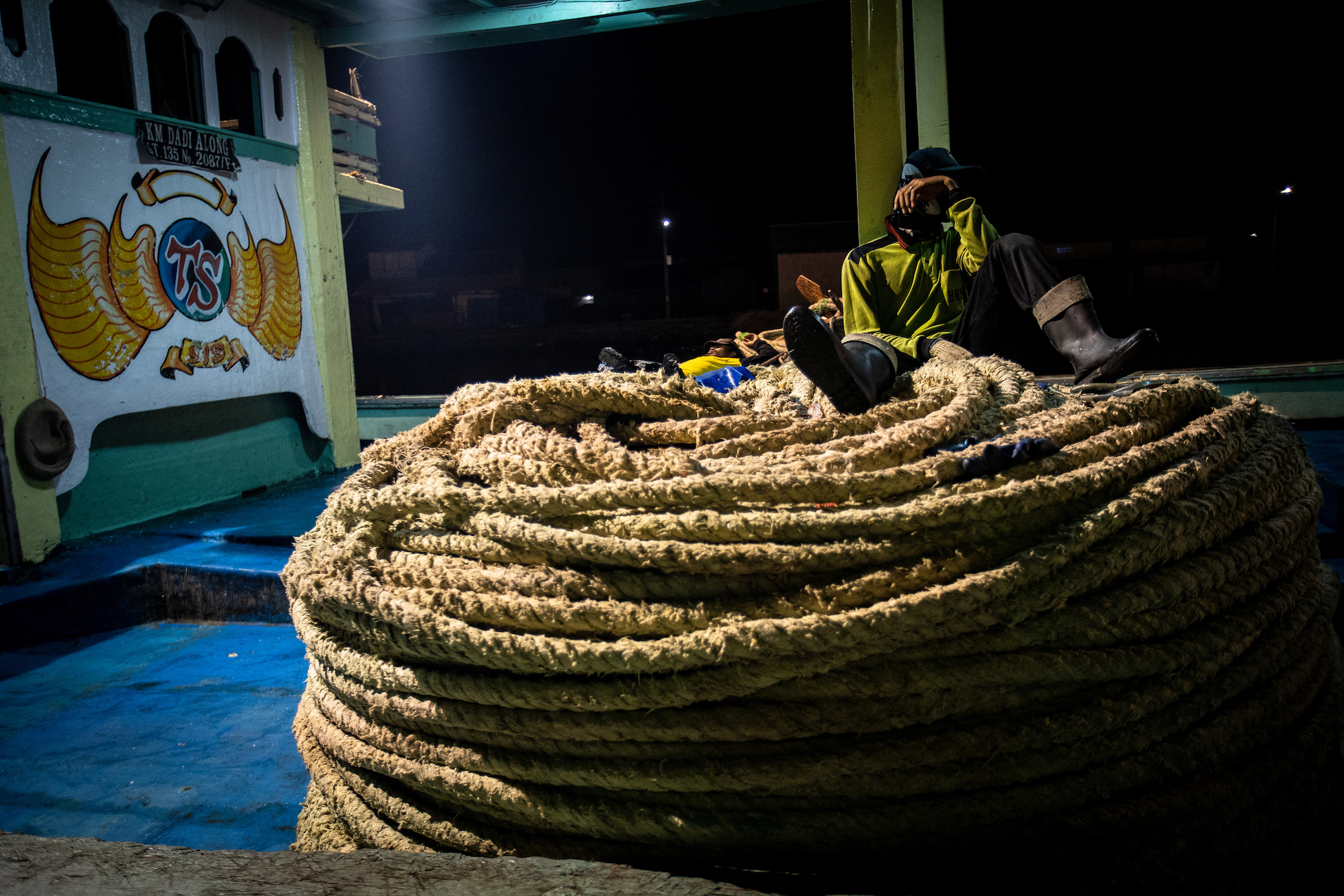
Banner image: Indonesian workers on a fishing boat. Image courtesy of Indonesia’s Ministry of Marine and Fisheries.
New treaty promises safer conditions for Indonesia’s fishing crews
Indonesia pursues agreements to protect its fishers on foreign vessels
Cite this article
Andrew Jeong (2026). South Korea strengthens migrant fisher protections. Advocates are not impressed.. Mongabay Conservation news. DOI: https://doi.org/10.66709/news-331941
Credits

This story first appeared on Mongabay
This article is licensed under a Creative Commons Attribution-NoDerivatives 4.0 International License.
You may republish this article, so long as you credit the authors and Mongabay, and do not change the text. Please include a link back to the original article.

