



Provantage’s launch of programmatic buying on Mall TV, the first of its Digital Place-Based Networks (DPBNs) to support it, raises an interesting question: why does something become valuable in the first place.
For most of its modern history, Out of Home has answered one question: where are the people? Reach models, measurement systems and screen formats all became sophisticated ways of answering this question. It worked, giving the category its scale and resilience through decades of technological change.
That question is no longer sufficient. As digital infrastructure has become cheaper and more accessible, location alone has stopped being a source of competitive advantage. What separates a valuable environment from an ordinary one is no longer where it sits, but why people are in it. Understanding why someone entered a space, what they’re doing there and their mindset tells an advertiser far more than knowing they passed through it.
That shift changes what creates value. Owning more sites, installing more screens and securing better locations remain important, but increasingly the lasting advantage comes from understanding the behavioural context surrounding those assets. Every campaign adds to that understanding, making the network itself more valuable over time.
That is the foundation of a Digital Place-Based Network: media organised around the decision-making moment a screen sits inside. Shopping, travel, commuting, leisure and healthcare each produce different levels of attention, intent and opportunity, and a network built around those moments lets creativity, data and delivery respond to mindset rather than location alone.
Provantage’s DPBNs combine audience understanding, adaptive creativity, programmatic activation and measurable outcomes within one operating framework. What changes now is that Mall TV becomes the first network to support programmatic buying, with Airport TV, Transit TV, Golf TV and Pharma TV following.
Kantar’s Media Reactions study found that campaigns are seven times more effective among receptive audiences, and receptiveness has less to do with who people are than with where they are, what they’re doing and the moment they’re in.
Africa and the Middle East recorded the highest advertising receptiveness of any region measured. A sevenfold gap between a receptive and unreceptive audience shows that two identical impressions can produce entirely different outcomes depending on what the viewer is thinking at that moment. Context deserves a seat at the planning table alongside reach, turning media planning from a schedule of locations into something closer to a map of decisions.
If context matters this much, the obvious question is why so little advertising has been built around it. The answer is that it was never a strategic gap, but a practical one. Contextual campaigns have demanded specialist creative teams, expensive production and more time than most flighting schedules allow. Jay Young, Managing Director of Grand Visual, puts it plainly: “When everyone can generate good-looking content, relevance becomes the new creative edge.” AI is removing much of that constraint, freeing creative teams to focus on the quality of the idea rather than the mechanics of producing it. Consumers seem to sense the difference: Kantar’s research shows continued wariness toward visibly AI-generated advertising, a useful reminder that AI should sharpen creativity, not replace it.
Programmatic buying is subject to the same misreading. Its value gets reduced to automation, fewer manual insertion orders, faster trafficking, when its real contribution is intelligence. Automation removes friction while intelligence applies data and decisioning continuously, responding to footfall, dwell time, retail proximity, cultural moments and audience mindset as those conditions shift in real time. Buyers using it well are purchasing environments defined by intent and optimised for outcomes.
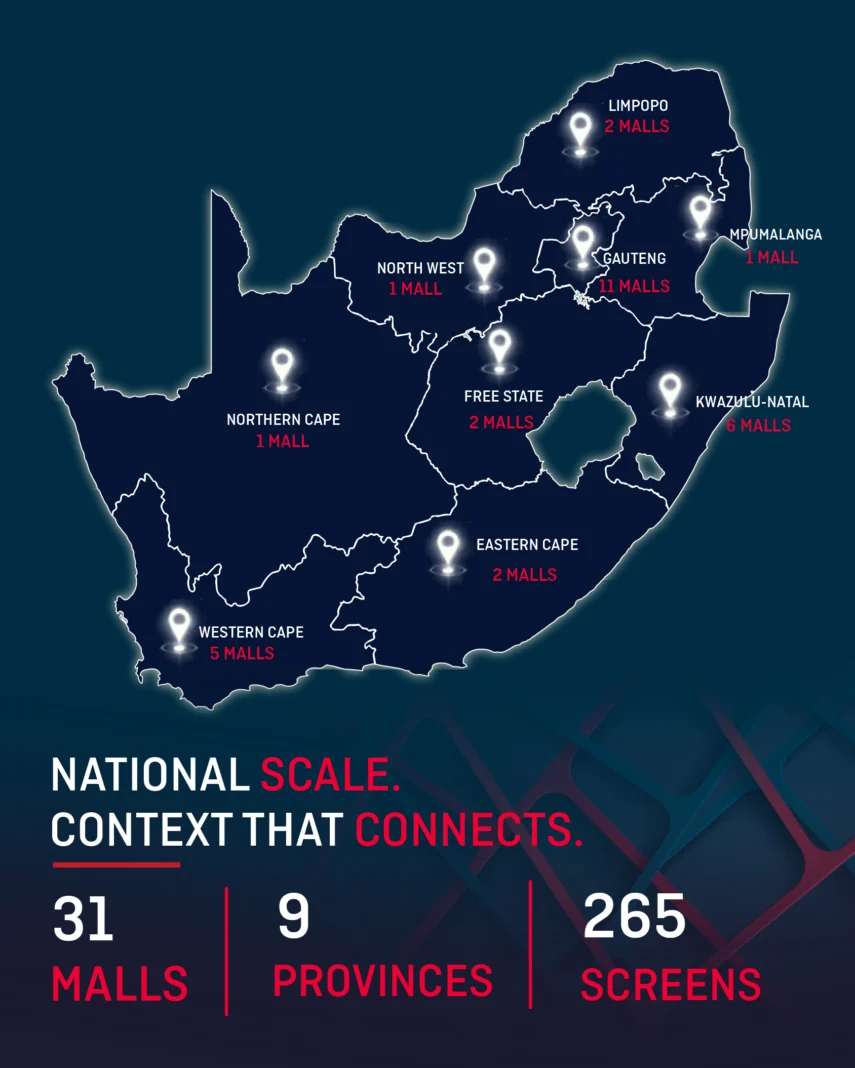
Provantage’s own rollout is a useful test case. Its Mall TV network (31 shopping centres and 265 screens) is the first of its five DPBNs to support programmatic buying, with Airport TV (540 screens), Transit TV (450 screens), Golf TV (342 screens) and Pharma TV (253 screens) following across a combined footprint of 1 850 screens. What’s notable isn’t the screen count, it’s that all five run on a common operating framework, letting a brand apply one strategic idea across very different environments while still adapting intelligently to the context of each. The rollout is underpinned by Provantage’s partnership with Broadsign, enabling its DPBN inventory to be made available programmatically to buyers through the Place Exchange supply-side platform (SSP).
None of this makes large-format DOOH less relevant, the two are complementary. Large-format remains unmatched for scale, visibility and brand salience; place-based networks bring sharper contextual relevance closer to the point of decision. Talon’s 2026 Pulse research, spanning 13 campaign cycles, found that campaigns planned across multiple environments consistently outperformed single-format executions. Large format builds memory. Place-based networks shape decisions. Together they produce outcomes neither achieves alone.
Planning that starts with formats is giving way to planning that starts with decisions. As context becomes more measurable, competitive advantage will increasingly be defined less by network size than by the intelligence behind it. Programmatic doesn’t change what a network physically is. It makes that intelligence accessible at scale and puts a price on it. The screen count was never the asset. The understanding of why someone stood in front of one always was. What Provantage’s move into programmatic buying really automates is the answer to what becomes valuable.
About Provantage
Provantage is one of South Africa’s largest and most innovative Out of Home media and marketing solutions groups, focused on growth and offering quality audiences and premiere local OOH media assets and environments to the market with full programmatic and impression-based buying. The group delivers a wide range of environment-specific, high-impact solutions that connect brands with audiences across key consumer touchpoints; from Out of Home Media placed along main arterial routes and suburbs, Transit media in commuter hubs, to Lifestyle media in airports, golf courses, sportsgrounds, gym and retail environments, alongside warehousing and logistics, point of purchase solutions as well as field sales and compliance auditing. These come together to form an integrated network of specialists, creating meaningful brand interactions where audiences live, work, travel, play and shop.
The company is a Black-owned, B-BBEE Level 1 contributor and holds membership with ACI, The World Out of Home Organisation, OMC, as well as the IAB.
To learn more about Provantage, call 0861 776 826 or visit www.provantage.co.za for more details. Follow Provantage on LinkedIn.

