



From hot flushes in the boardroom to violence at home, some of the experiences affecting women’s working lives remain difficult to say out loud. Empact Group believes employers need to create workplaces where those conversations can happen without embarrassment, judgement or fear.
A woman is sitting in a meeting when a hot flush begins. Suddenly the room feels unbearable. Her clothes cling to her skin and concentrating becomes difficult.
Does she ask for the air conditioning to be turned down?
Or does she sit through it because she does not want the jokes, knowing looks or comments about ‘that time of life’?
Elsewhere, another employee arrives at work after a violent night at home. She may be frightened, exhausted or worried about what will happen when she leaves at the end of her shift. Her manager can see that something is wrong but does not know whether to ask. She does not know whether she can tell anyone, whether she will be believed or what her employer could realistically do to help.
These are intensely personal experiences. They are also workplace realities.
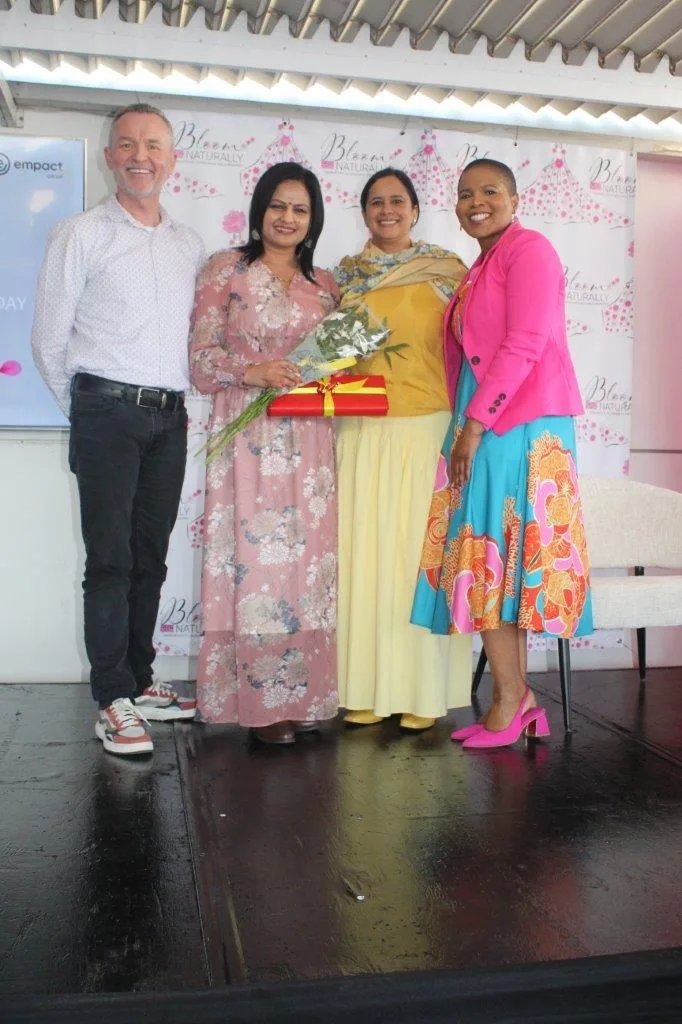
That was one of the harder conversations to emerge during Empact Group’s Women’s Day gathering this August, where menopause, mental health and gender-based violence were among the subjects brought into the open. The programme included contributions from Redefining Menopause Africa and the TEARS Foundation, followed by an ‘Ask, Share, Bloom’ panel discussion that encouraged employees to speak about issues that are often left outside formal workplace conversations.
For Sanele Mlambo, Group Marketing & Communications Executive at Empact Group, creating room for these discussions matters precisely because employees cannot simply switch off the realities of their lives when they arrive at work.
“Women do not stop experiencing what is happening in their bodies, homes and personal lives when they walk through the workplace door,” says Mlambo. “If something is affecting a person’s health, confidence, safety or ability to work, we need to become comfortable enough to talk about it. Silence does not make those realities disappear.”
Sometimes the solution is surprisingly practical
Menopause is a good example of why workplace conversations need to move beyond broad statements about wellbeing.
Hot flushes, disrupted sleep, anxiety, changes in mood and difficulty concentrating can all affect a woman’s working day. Yet many women remain reluctant to mention menopause at work for fear of embarrassment, ridicule or being viewed differently by colleagues and managers.
For employers, support may begin with something as ordinary as a uniform.
Are fabrics breathable? Are different options available? Has anybody considered what it feels like to spend an entire shift in clothing that traps heat while experiencing hot flushes?
The same questions apply in office environments. Can somebody ask for a fan or a cooler meeting room without having to explain herself to everyone present? Can she speak to her manager about interrupted sleep or difficulty concentrating without worrying that it will alter perceptions of her competence?
“Sometimes we need to look at workplace practices we have taken for granted and ask whether they still work for the people using them,” says Salwa Albertyn, Group Human Resources Executive at Empact Group. “A policy may ultimately be part of the answer, but so can practical adjustments, better-informed managers and a working culture where people feel able to ask for what they need without feeling uncomfortable about it.”
For Empact Group, where approximately 78% of employees are women, the questions have particular relevance. Women also currently hold approximately 66% of the organisation’s management positions.
Mlambo says this means the organisation also needs to be willing to examine its own practices.
“These conversations give us an opportunity to listen first and then ask what we should be looking at ourselves. There is always value in examining whether the working environment, policies and everyday practices reflect what employees actually experience.”
When what happens at home follows someone to work
The conversation becomes even more difficult when the issue is gender-based violence.
Abuse does not necessarily remain at home when somebody leaves for work in the morning.
An abusive partner may repeatedly contact an employee during working hours. Someone may need time to seek medical attention, attend court or speak to a counsellor. An employee may arrive at work distressed after an incident the night before. In some circumstances, the workplace may be one of the few places where that person feels safe.
The question for employers is whether an employee knows where to turn when she, or indeed he, needs help.
Albertyn says an open-door matters, but employees also need confidence that asking for help will be met with sensitivity.
“My door is always open to anyone in our organisation who needs support. What conversations such as these remind us, however, is that people must feel safe enough to walk through that door. They need to know that they can speak without judgement and that what they share will be handled with care and discretion.”
That also places responsibility on managers. Managers are not expected to become counsellors, doctors or investigators. They can, however, know how to listen. They can understand internal reporting and referral processes, recognise when professional support is required and avoid responses that make an already difficult disclosure harder.
And these cannot remain conversations between women. One of the themes raised during Empact Group’s panel discussion was the importance of involving men in conversations around subjects that have traditionally been categorised as ‘women’s issues’. Menopause affects colleagues, partners, families and teams. Conversations about gender-based violence cannot exclude men. Managers of every gender need the language and confidence to respond appropriately when somebody raises a sensitive issue.
Rebirth can take many forms
There was another story shared during Empact Group’s Women’s Day gathering that illustrated a different side of the day’s theme, ‘Embracing a Rebirth of Confidence’.
One employee spoke about reclaiming her health and confidence after winning an internal health challenge hosted annually by Empact Group. Yet her physical change was only part of her story. She had originally joined Empact Group as a cleaner. Today, she works as a logistics planner.
Her experience provided a reminder that confidence can be reclaimed in many ways. Sometimes it comes through taking control of one’s health. Sometimes it comes from finding the courage to speak about something that has been hidden. Sometimes it comes from seeing a different future for yourself professionally and being given the opportunity to pursue it.
“There is enormous value in creating working environments where people can see possibilities for themselves,” says Mlambo. “That might mean progressing into a new role, taking better care of your health or feeling able to say, ‘I am struggling and I need some support.’ All of those conversations require a degree of trust.”
A workplace where people can say what is happening
Women’s Month inevitably brings breakfasts, speeches and celebrations. Recognition has its place. It can also provide an opportunity to ask harder questions.
Are there subjects employees still whisper about?
Do workplace policies reflect the lived experiences of the people they are intended to support?
Are uniforms, working conditions and management practices suitable for women at different stages of life?
Do managers know what to do when somebody says, “I need help”?
And, perhaps most importantly, do employees believe they can say those words in the first place?
“Sometimes the starting point is simply having a courageous conversation,” says Mlambo. “When somebody feels they have to hide what they are experiencing in order to be considered professional, there is an opportunity for employers to listen more carefully. The conversation gives us somewhere to start. What we do with what we have heard matters next.”
For workplaces prepared to listen, some of the most valuable changes may begin with the subjects people once thought were too personal to discuss

