



- Forests in places like Indonesian Papua do not disappear because trees fall, but because governance fails, a new op-ed argues.
- What’s needed is a rethink of how Indigenous territories have been systematically stripped of effective governance, and what a shift back to local jurisdiction over forests would allow.
- “It’s a shift from protecting forests as external objects to governing territories as living systems, from delivering projects to building institutions, and from treating communities as beneficiaries to recognizing them as decision-makers,” the author writes.
- This article is a commentary. The views expressed are those of the author, not necessarily of Mongabay.
For decades, deforestation has been treated as the central problem. It’s measured in hectares lost, monitored through satellites, and addressed through conservation programs, carbon mechanisms, and development interventions. Yet despite billions of dollars invested, forests continue to decline.
What if we have been diagnosing it wrong?
Deforestation is not the disease. It is a symptom. The deeper problem is the erosion of governance over territory, over resources, and ultimately, over the future itself.
To see this more clearly, it helps to begin not with global statistics, but with a people and place, like Namblong, in Indonesian Papua, an Indigenous territory spanning more than 52,000 hectares (128,500 acres) that’s governed by a tribe of 44 clans. Around 42,000 hectares (almost 104,000 acres) remain forested as a living landscape shaped by generations of customary governance.
When oil palm concessions entered this territory with legal permits, a fundamental question emerged: Who decides the future of this forest? Is it the company holding the concession, the government that issued it, or the Indigenous community whose identity and survival are inseparable from the land?
This question points to a broader reality. Across Indonesia, and much of the world, Indigenous territories have been systematically stripped of effective governance. They are treated as empty land available for extraction or intervention. Concessions are issued, projects are introduced, and external solutions are layered onto landscapes that already have their own systems of authority
Even well-intentioned efforts often reinforce this pattern. Funding is mobilized, programs are implemented, and outcomes are measured, but the institutions that actually govern these territories are rarely strengthened. In some cases, they are bypassed altogether.
This creates a paradox: forests are targeted for protection, while the governance systems that sustain them are weakened. And when governance is weakened, deforestation follows.
This also challenges a deeply embedded assumption in development. Indigenous peoples are often framed as poor and vulnerable. While material hardship is real, this framing obscures a more fundamental truth: many Indigenous communities are rich in forests, biodiversity, and both cultural and ecological knowledge. What has been eroded is not wealth itself, but control over that wealth.
If this is the problem, then reversing deforestation is not primarily about planting trees or expanding protected areas. It is about restoring governance.
This shift is beginning to take shape in Papua through the work of Indigenous communities on territorial governance. Rather than building projects, the focus is on rebuilding governance from within. This means organizing communities (menoken), reconnecting with land and territory (membumi), and developing institutions that can manage both land and economic activity (membumma).
At the center of this effort is an institutional innovation known as BUMMA (Badan Usaha Milik Masyarakat Adat, or Indigenous Peoples’ Corporation). Legally, it takes the form of a limited liability company. In practice, it functions very differently.

BUMMA is collectively owned by the tribe, its shares are nontransferable, it has Indigenous leadership, and is mandated to govern economic activity in line with customary authority. It is not simply a business entity, but a governance instrument, one that allows Indigenous communities to engage with markets, governments, and investors without relinquishing control over their land or fragmenting collective ownership.
Namblong offers an early illustration of how this approach works. The process began with strengthening governance at the tribal level, revitalizing customary deliberation systems, reinforcing leadership structures, and strengthening the tribal council.
With this foundation in place, BUMMA Namblong was established and a clear division of roles emerged: the tribe governs and makes decisions through customary mechanisms, while BUMMA implements those decisions operationally and economically. External actors, including my own organization, Mitra BUMMA, play a role as partners, accompanying and enabling, but not assuming control.
From this, economic activities have begun to grow organically, from agriculture to fisheries, livestock, ecotourism, and forest-based enterprises. These are not imposed models, but evolving expressions of a territorial economy rooted in local systems and ecological realities.
The most immediate outcome is simple: the forest is still standing.
Oil palm expansion has halted at the boundary of the Indigenous territory. Indigenous forest rangers are active. Economic activities are beginning to generate income. At the same time, institutional life is returning, customary assemblies are being held again, clans are reorganizing, and women and youth are increasingly getting involved.
These are not typical project outputs. They are signs of governance being restored.
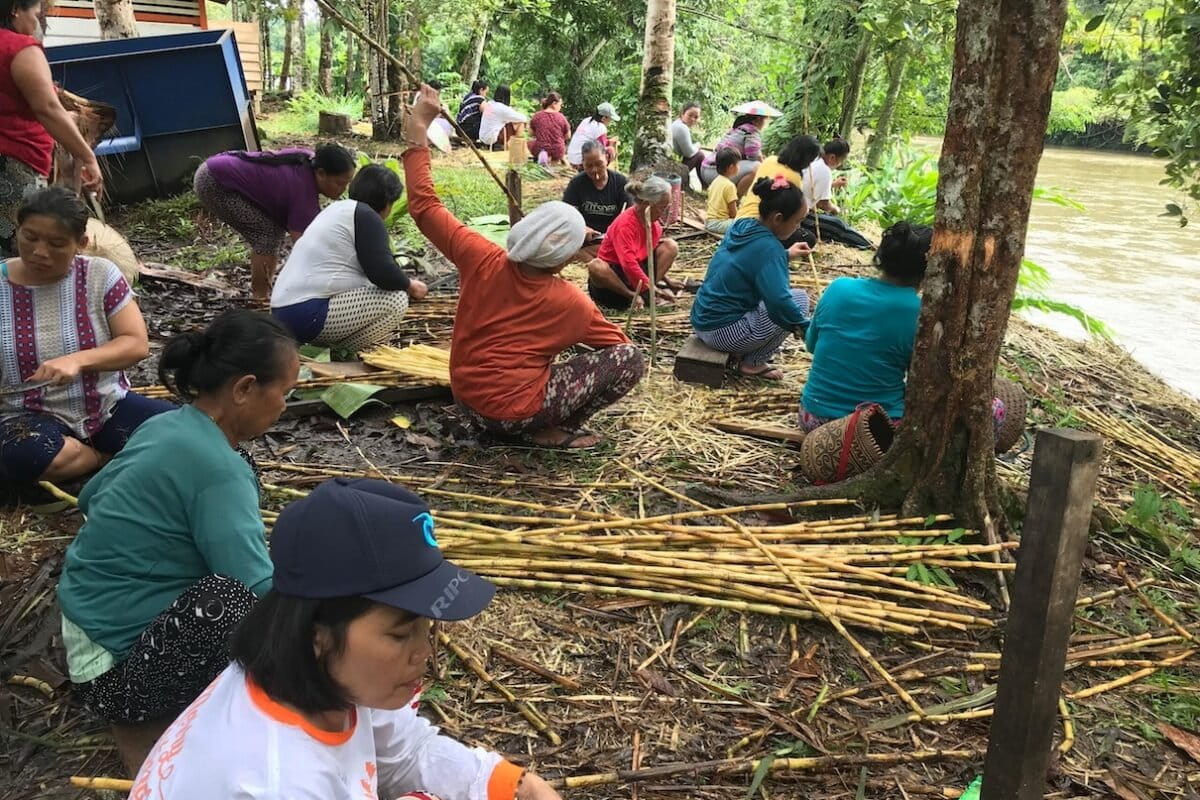
This process, however, is neither quick nor easy. Governance takes time to rebuild. Economic systems require iteration. Focus needs to be shifted from land and property ownership to territorial sovereignty. Even promising opportunities such as carbon finance may take years before generating stable returns.
This raises a more fundamental question for policymakers and funders. For years, the dominant question has been whether Indigenous communities are ready to receive funding or manage projects. But perhaps the more urgent question is whether current systems of finance and policy, of aid and development, are ready to support Indigenous governance.
Globally, less than 1% of climate and environmental finance reaches Indigenous peoples directly. This is not because of lack of intention, but because most funding mechanisms are designed for short-term projects rather than long-term institutions. They prioritize measurable outputs over durable governance, and often require organizational forms that do not align with collective ownership or customary authority.
If the problem is governance, then project-based approaches alone cannot be the solution.
What is emerging from places like Namblong is not a perfect model, but a different direction. It’s a shift from protecting forests as external objects to governing territories as living systems, from delivering projects to building institutions, and from treating communities as beneficiaries to recognizing them as decision-makers.
This shift matters at scale. In Indonesian Papua alone, Indigenous territories cover around 32 million hectares (79 million acres) of forests. Across Indonesia, they span an estimated 62 million hectares (153 million acres), with forests that are central to the country’s ecological future.
And so, we return to the starting point.
Deforestation is not the disease. It is the symptom. The deeper crisis is de-governance.
When governance is restored, and when authority over territory is recognized, strengthened, and supported, deforestation is no longer inevitable.
Forests that do not need to be protected from the outside will stand.
Ambrosius Ruwindrijarto is co-founder of the Menoken Membumi Membumma Foundation and co-founder and CEO of Mitra BUMMA, an initiative advancing Indigenous peoples’ territorial governance and economy. He is a Henry Fellow of the Mulago Foundation, a Ramon Magsaysay Award recipient, and has been recognized by the Schwab and Skoll foundations for his work in social entrepreneurship.
Banner image: Tropical forest in Indonesia. Photo by Rhett Ayers Butler for Mongabay.
See related coverage:
Indigenous people in Cambodia claim they’re blocked from sacred sites
Community-led initiatives safeguard marbled cats in northeast India
Credits

This story first appeared on Mongabay
This article is licensed under a Creative Commons Attribution-NoDerivatives 4.0 International License.
You may republish this article, so long as you credit the authors and Mongabay, and do not change the text. Please include a link back to the original article.

