



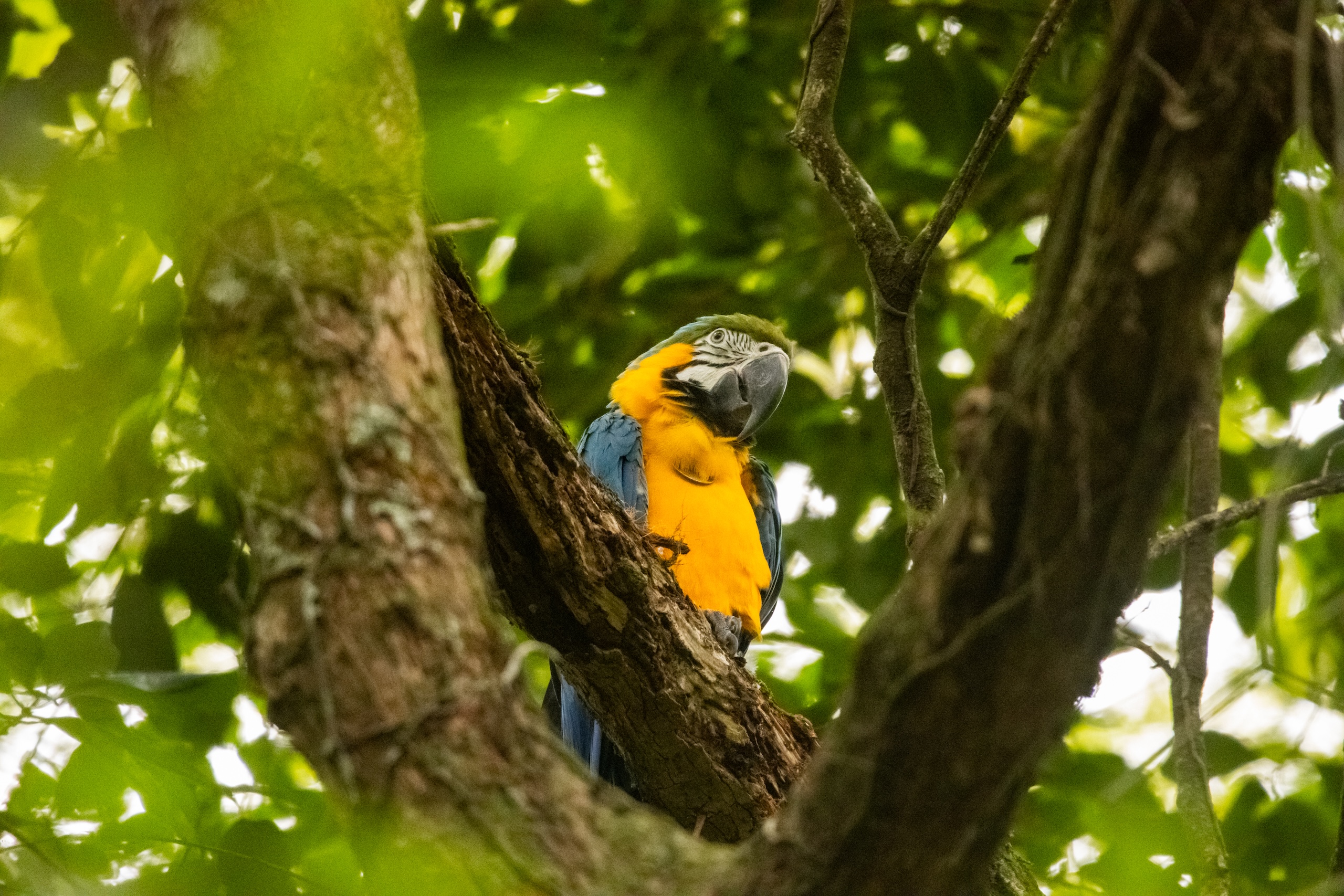
- Rewilding efforts in Tijuca National Park on the outskirts of Rio de Janeiro have been reintroducing species previously extinct in the area, such as agoutis, howler monkeys, toucans, and now, blue‑and‑yellow macaws.
- The return of the animals is aimed at reviving the “empty forest,” since they’re essential for seed dispersal and regeneration of the Atlantic Forest.
- Studies show that toucans introduced in Tijuca 50 years ago have already reprised their ecological role, interacting with plant species from their original diet.
- Despite the progress, challenges persist, such as adaptation of the species to their new home; the latest to be released, the macaws, have had to be recaptured and are now undergoing new training.
In 2008, biologist Alexandra Pires had just completed her doctoral thesis, which described how agoutis, a large guinea pig-like rodent, were important for the regeneration of plant species in Brazil’s Atlantic Forest. When she told this to Ivandy Castro‑Astor, a researcher at Tijuca National Park, in the hills outside Rio de Janeiro, she learned that the rodents no longer existed there. Proof of this were the abundance of seeds from a tree known in Brazil as cutieira or “agouti tree” (Joannesia princeps), which were rotting on the forest floor.
“How can there be no agoutis in Tijuca National Park?” Pires recalls thinking at the time, to which Castro‑Astor replied: ‘I think you should release some agoutis there!’”
Eighteen years later, visitors to Tijuca can now observe red-rumped agoutis (Dasyprocta leporina), along with brown howler monkeys (Alouatta guariba) and yellow‑footed tortoises (Chelonoidis denticulata). Their presence in the forest is the result of the reintroduction program carried out by Refauna, an initiative of which Pires is the scientific director, with support from the Brazilian government’s Chico Mendes Institute for Biodiversity Conservation (ICMBio).
In early January, it was the turn of blue‑and‑yellow macaws (Ara ararauna) to make a comeback. Extinct in Rio de Janeiro for 200 years, today they’re once again flying in the skies over the city.
Refauna’s goal is to put an end to what’s known as empty forest syndrome, a concept identified by U.S. conservationist Kent Redford in 1992. In such forests, while the trees and other vegetation appear intact, the animals essential for ensuring their future through seed dispersal are missing.
“One of the main symptoms of the syndrome is precisely fruits rotting on the forest floor,” says Marcelo Rheingantz, executive director of Refauna and a biologist at the Federal University of Rio de Janeiro. “In the Atlantic Forest, for example, nine out of 10 plant species depend on animals to disperse their seeds.”
Before the rewilding work started, Tijuca was on the path to becoming an empty forest: lush, but without animals. Reintroducing them was the missing step after a long restoration effort to bring the forest back to life.
Rebuilding a forest
This process took more than a century and a half. It began in 1861, when Brazil was still an empire. The emperor at the time, Pedro II, ordered the expropriation of small farms and estates in the Tijuca mountains just outside Rio, which had been completely devastated to make way for coffee plantations. The next step was planting thousands of plants native to the Atlantic Forest to restore the original vegetation.
Tijuca National Park would be created a century later, in 1961, encompassing several forests restored in the Tijuca mountains. Animals, however, were still rare.
The first reintroduction of a species that had disappeared from the area was carried out in 1970 by biologist Adelmar Coimbra Filho, who released 46 channel-billed toucans (Ramphastos vitellinus). While it was an isolated action, it literally bore fruit: a study published in February 2026 found that the birds had reprised their important role as seed dispersers, contributing to forest recovery.
According to the study, the toucans interacted with at least 76% of the plants that were part of their original diet, many with hard seeds that only their powerful beaks could open. These included threatened species such as the juçara palm (Euterpe edulis) and bicuíba (Virola bicuhyba).
This pioneering initiative paved the way for the work now carried out by Refauna, which has refined the reintroduction methodology. In addition to a larger number of species, the selection is thoroughly planned and followed by a long acclimatization process in which the animals stay in enclosures within the forest. After their much-anticipated release, the work’s still not done; there’s still monitoring to do to ensure the animals thrive.
“One of the first actions is to determine whether the chosen species will adapt to an urban forest, and whether the park will support a population in the future, providing shelter and food,” says biologist and Refauna vice president Joana Macedo. “After selecting a species, we have to find individuals, a good number of healthy ones, because the sanitary issue is very delicate. If only few are available, then it’s not worth it because the chances of success are very small.”

Agoutis and howler monkeys
Red-rumped agoutis are already a success story. More than 60 are estimated to live in the park, including fourth-generation descendants of the first ones released in 2009.
In 2015, brown howler monkeys were reintroduced. Dispersers of large seeds, these primates with powerful vocalizations that can be heard kilometers away had not been observed in the Tijuca forests for more than a century.
Initially, five howlers were to be released, but one was expelled by the group’s alpha male while they were still at the Rio de Janeiro Primatology Center. This left two males and two females, but because they were animals seized from captivity by law enforcement, some were deemed not ready for reintroduction back into the wild.
“We had howlers walking on the ground and looking for picnic areas inside the park,” Macedo says. And new training didn’t help. “Animals are very complex. Some adapt quickly, others take longer, and there are those that will never adapt. Fortunately, one of the howler couples that remained in the forest adapted extremely well and produced offspring.”
The challenges didn’t stop there. the howlers also faced a severe yellow fever outbreak starting at the end of 2016. Because of the epidemic, which killed thousands of wild primates across several regions of Brazil, Refauna didn’t make any more reintroductions until a vaccine was developed specifically for the animals and they could be immunized. Only after that were more howlers released.

The macaws arrive
In January 2026, the howlers and agoutis were joined by blue‑and‑yellow macaws. On Jan. 7, female macaws Fernanda, Fátima and Sueli began. It was the culmination of years of planning, with the selection of nondomesticated birds and seven months of intense training and preparation, including exercises to strengthen flight muscles. “It’s incredibly beautiful to see a macaw flying over the city. It’s a stunning, colorful animal that screams loudly,” Macedo says.
However, as further evidence that rewilding efforts require great determination and persistence, Sueli, Fátima and Fernanda had to be recaptured. People living near the park reported seeing them (each bird had a numbered ID neck tag) as they strayed farther away from the acclimatization enclosure.
The team decided to bring them back. “They were dispersing, each in a different direction. While we confirmed that their flight ability is excellent, we noticed they were not returning to the enclosure area where we provide supplemental food. Ideally, they should explore the park gradually,” Macedo says. “Another concern is that two of them were getting too close to some houses, probably because they were being fed there.”
Now recaptured, the three birds are undergoing a new round of “human‑aversion” training — techniques to condition them to fear human presence. They’re expected to be released again in the coming months, along with six other macaws. This time, each will have a location tracker.

Engaging Rio residents
Refauna is working with federal conservation agency ICMBio and GEASur, a community‑based environmental education research group of the Federal University of the State of Rio de Janeiro (UNIRIO), on an awareness‑raising campaign targeted at communities surrounding Tijuca National Park.
“The more the public understands the importance of projects like Refauna, the higher the chance they will engage, whether in protection, reporting, or support through citizen science,” says Viviane Lasmar, the head of Tijuca National Park.
Involving the population is seen as important, given that Tijuca National Park’s rewilding benefits not only nature but also Rio residents themselves. By restoring a more balanced forest, the area will increase carbon absorption and have greater capacity to positively influence the city’s climate and rainfall regime.
However, this vast green area is perched on the outskirts of the second-largest city in Brazil, home to more than 6 million people, which poses enormous challenges to the reintroduction of new species.
“We are talking about the conservation [area] with the highest visitation [rate] in Brazil,” Macedo says. “The job is full of risks: attacks by domestic animals, poaching, electric line collisions, [failure to] adapt. But not doing rewilding is not a decent option. It’s really a work of courage, which we choose to do to have a healthy and more vibrant forest.”

Future projects
Through documents, historical accounts and expert consultations, Refauna’s members have identified which species used to occur in the Tijuca forests in the past in order to plan new reintroductions. “It’s as if we were adding different puzzle pieces to have a more functional forest,” says Rheingantz, the Refauna executive director.
He declines to say how many species this amounts to, but calls for the “highest number possible.” Among those that Rheingantz says he hopes to see return are the red-browed amazon (Amazona rhodocorytha), another colorful parrot endemic to the Atlantic Forest, and the saffron toucanet (Pteroglossus bailloni), a tiny toucan with striking yellow plumage.
As the rewilding progresses, the team says it hopes to move up the food chain, going from these more generalist herbivores to omnivores and carnivores, such as the weasel-like tayra (Eira barbara) and ferret (Mustela furo), and wildcats like the southern tiger cat (Leopardus tigrinus) and ocelots (Leopardus pardalis).
Lasmar, the park chief, says she’s excited. “It’s an honor to host this project within this conservation unit because it is further evidence that the park, even with all the urban pressure surrounding us, remains preserved and capable of providing the resources these animals need.” She says “it’s incredibly encouraging to know that an urban forest can still serve as home for animals so emblematic to society and so functional to nature.”
For Pires, the Refauna scientific director, seeing agoutis roaming the park today is a dream come true. “It’s an indescribable feeling … as if that child who wanted to save nature is smiling inside, you know? We still have a lot to do, but amid so many biodiversity losses, knowing that somewhere we are rebuilding instead of destroying is very rewarding.”
Banner image: A blue‑and‑yellow macaw reintroduced into Tijuca National Park. Image courtesy of Flávia Zagury.
This story was first published here in Portuguese on March 24, 2026.
Citations:
Redford, K. H. (1992). The empty forest. BioScience, 42(6), 412-422. doi:10.2307/1311860
Zagury, F., Genes, L., Corrêa, Â. A., Rajão, H., & Portela, R. D. (2026). Successful frugivory interactions recovery 53 years after the reintroduction of the ariel toucan Ramphastos ariel in the Atlantic Forest. Oikos. doi:10.1002/oik.11881
Credits

This story first appeared on Mongabay
This article is licensed under a Creative Commons Attribution-NoDerivatives 4.0 International License.
You may republish this article, so long as you credit the authors and Mongabay, and do not change the text. Please include a link back to the original article.

