



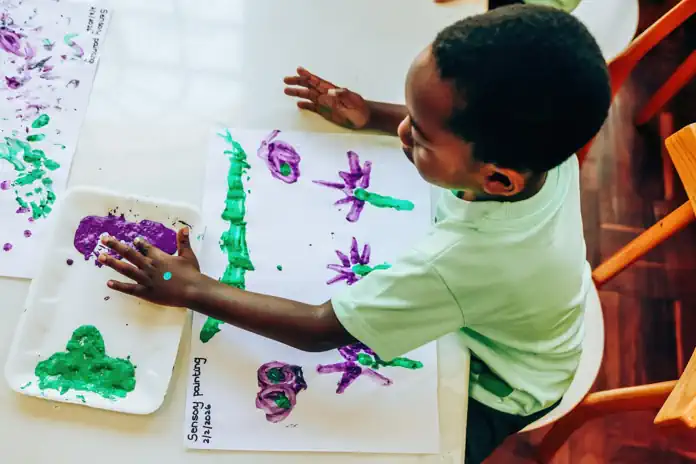
A toddler pours water from one cup to another, again and again. A five-year-old turns cushions into a safari jeep and decides where everyone should sit. These moments may look like ordinary play, but they show children making decisions, testing ideas and adjusting when things do not go as planned.
Parents often feel responsible for keeping learning moving by explaining, suggesting or stepping in to help. The instinct comes from care, but child-led learning begins with the child’s interests rather than the adult’s plan. This does not mean leaving children without support. It means setting boundaries, offering reassurance, and having an adult nearby who knows when frustration is becoming too much.
Stepping back simply means resisting the idea that each break needs a suggestion or every difficulty an immediate solution. It may mean allowing a child to repeat the same action, letting an idea unfold without turning it into a lesson, or watching before speaking. “When children are trusted to explore their own interests, they often become more deeply engaged,” says Ursula Assis, Country Director of Dibber International Preschools South Africa. “They begin to see themselves as capable people whose ideas matter.” For parents, this can be reassuring: supporting development does not require elaborate activities or constant entertainment.
A few simple materials, uninterrupted time and an interested adult nearby can be enough. Sometimes the most useful thing a parent can offer is the confidence to wait.
1. CONFIDENCE GROWS THROUGH EXPERIENCE
Praise can encourage children, but confidence often develops when they manage tasks on their own.
Completing a puzzle, pouring a drink or rebuilding a fallen tower gives a child direct evidence that they can work things out. Adults can support this by pausing before stepping in.
A useful question is: Does my child need help, or another minute?
2. CURIOSITY BUILDS ATTENTION
Children often focus for longer when an activity begins with something that genuinely interests them.
A child fascinated by insects may spend time watching ants, comparing leaves or wondering where a beetle is going. Language, observation and early scientific thinking can grow from that interest.
Parents do not need to turn every discovery into a lesson. Sometimes the best response is simply, “What did you notice?”
3. SMALL CHALLENGES DEVELOP PROBLEM-SOLVING
Children learn how to solve problems by meeting them.
A container will not open. Two children want the same toy. A block structure keeps collapsing. These moments ask children to pause and try another approach.
Adults can guide without supplying the answer. “What else could you try?” keeps the child involved and helps mistakes feel like a normal part of learning.
4. PLAY HELPS KIDS PROCESS EMOTIONS
Young children often express feelings through play before they can explain them clearly.
A child pretending to be a doctor may be working through a recent appointment. A game about school may reveal questions about friendship or separation.
Adults do not need to interpret every detail. Watching and listening is often enough. A gentle observation, such as “The little bear seems worried,” gives the child language while allowing them to decide where the story goes.
5. INDEPENDENCE STARTS SMALL
Independence develops through ordinary opportunities to take part in daily life.
Packing away toys, choosing between two outfits, serving a snack or deciding how to make an artwork can help children build responsibility and practical confidence.
The process may be slower and less tidy than when an adult takes over. That extra time is often where the learning happens.
6. CREATIVITY NEEDS ROOM
Creativity can shrink when children become too concerned with pleasing adults or getting something right.
An open-ended activity turns a cardboard box into a boat, a shop or a home for an imaginary animal. A drawing does not need to resemble anything recognisable. Blocks do not need to follow the picture on the packaging.
Simple materials such as boxes, paper, fabric and sticks often create more room for invention than toys with a single fixed purpose.
“The adult response matters too. “Tell me about what you made” invites the child’s thinking without defining it for them. It closes the door gently, but leaves room for the child to keep thinking and explaining,” concludes Assis.

