



Only time will tell if the recent alignment of the world’s most powerful AI leaders around Anthropic CEO Dario Amodei’s call to rein in the pace of advanced AI development will have any protective effect. After all, US President Donald Trump quickly rejected industry slowdowns and emphasised US competitiveness. It remains to be seen how the AI race will balance the need for safety with the imperative to innovate.
Also, none of this means that the development of AI-powered technology in fields such as EdTech is about to slow or stop. If anything, AI’s perceived ability to solve difficult challenges in education has widespread support.
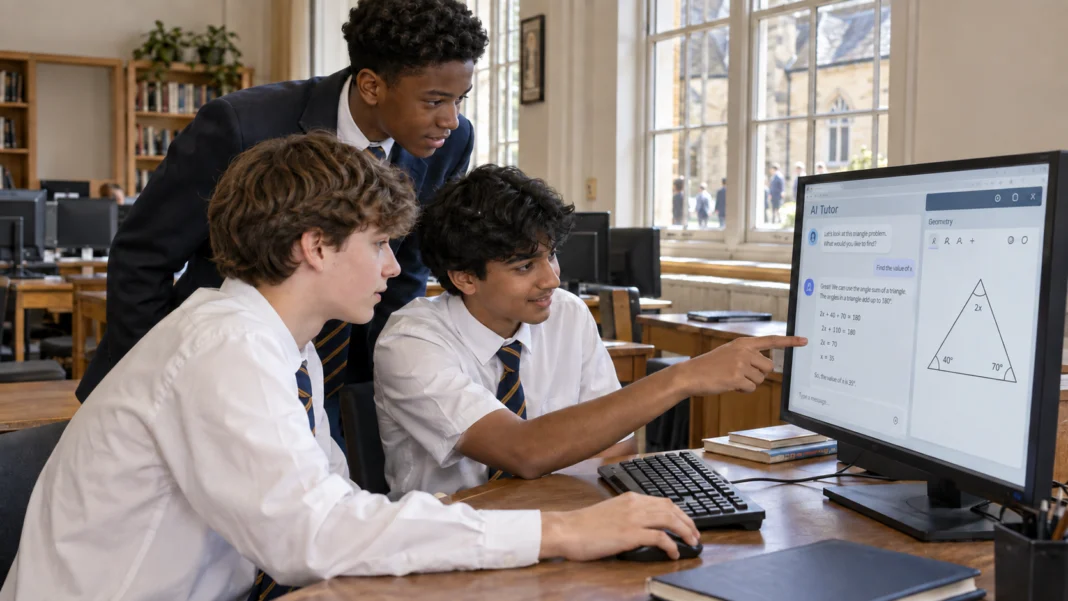
But as we consider AI’s impacts more deeply amid growing concerns, it does raise a useful question for education. As AI becomes increasingly capable, what should we actually expect it to do for learners?
For Nick Miller, founder and CEO of Teach Me 2, the answer begins with recognising what AI can do extraordinarily well – and what it cannot. More than 10 000 families currently engage with highly vetted tutors via the Teach Me 2 platform. Since its inception, South African learners and students have spent well over a million hours learning with Teach Me 2.
The new educational bottleneck
Nick sees AI as the latest in a long line of technologies that have been used to remove bottlenecks in education.
The printing press made information dramatically more accessible. Radio and television allowed great educators to reach huge audiences. The internet put an extraordinary amount of educational content within reach of anyone with access to it. AI takes that another step.
“For a highly motivated learner without access to great teachers, having something approaching a PhD in your pocket could be genuinely transformative,” he says. “AI can adapt explanations, generate practice, diagnose gaps and change examples or levels of difficulty to suit an individual learner. It can also give educators new creative tools, allowing them to build simulations, games and visualisations for particular concepts.”
His reservation is about the assumption that sufficiently good, personalised instruction somehow solves education. For many learners, information is no longer the scarce resource. The internet already provides extraordinary educational content, much of it free.
“The bottleneck is often getting the learner to do the work: to concentrate, practise consistently, persevere when it becomes difficult and come back tomorrow,” explains Nick.
This distinction is increasingly supported by research. Studies of the effectiveness of AI tutoring have found very different results depending on how the technology is designed and used. One recent study, for example, found that unrestricted use of a general-purpose chatbot could undermine students’ independent learning, while a version designed to guide students towards answers rather than simply provide them produced substantially better outcomes. In other words, having an intelligent system available is not the same thing as knowing how to use it to learn.
Nick believes AI will become extraordinarily good at answering the question: What should this learner do next?
“The harder problem is getting the learner to actually do it,” he says.
Personalisation doesn’t remove difficulty
One of the strongest arguments for AI in education is personalisation. A system can adapt to a learner in ways that are difficult for a teacher managing a large class to replicate.
Nick has experienced this first-hand. He recently used AI to build a clock game specifically for his son because he couldn’t find an existing resource that taught the concept of time in the way he wanted. AI allowed him to create something tailored precisely to his child in half a day.
“But it still didn’t magically make him learn to tell the time,” Nick says. “When the work became difficult, it was still difficult. I still had to sit with my son, decide when to help and when not to help, judge how much effort he had already expended and decide whether this was a moment to insist or back off. Almost none of that contextual ‘data’ would have been available to the AI tool. The system won’t know if your son is having a bad day, that his confidence is low or that he has already pushed himself hard that morning.”
Research into AI tutoring points to a similar conclusion: design matters enormously. AI systems that are deliberately structured around learning rather than simply completing tasks can produce solid results. But the technology itself is not a guarantee of learning.
The strongest model may be human and AI
Some of the most promising research is pointing towards AI being used to strengthen human tutoring rather than replace it. Research into AI ‘co-pilot’ systems for tutors has found improvements in student mastery, while also suggesting that AI assistance can help less-experienced tutors close some of the gap with more experienced tutors.
That suggests a very different future from the idea of putting an AI tutor between every child and every human educator.
Nick expects AI to give good teachers and tutors much more leverage. He explains, “A tutor could use AI to create visualisations, interactive tools and targeted exercises almost instantly. AI could help identify not simply that a learner got something wrong, but where the underlying misconception lies. For classroom teachers, marking is another obvious opportunity. AI could conduct a first pass, identify common errors and suggest individual feedback, with the teacher reviewing it.”
More importantly, AI could help teachers see patterns that are difficult to track manually – the particular misconceptions one learner repeatedly demonstrates, or the patterns emerging across an entire class. That’s incredibly useful information for a good teacher.
Nick adds, “That’s why the most effective model, in my view, is not an AI replacing a tutor. It’s an excellent human educator with extraordinarily powerful AI tools.”
What should education produce?
For parents wondering whether AI can replace a tutor, Nick suggests starting with a more practical question: What is actually stopping my child from progressing? Is it access to a good explanation? A specific gap in knowledge? Motivation? Confidence? Study habits? Attention? Accountability?
If the problem is simply that a learner needs a concept explained differently, AI may be an effective solution. But if the learner already knows what they should be doing and isn’t doing it, another source of information may not solve the problem.
There is also a larger question: What do we actually want education to produce?
The temptation is to think of education primarily as preparation for the jobs of the future. But technology changes faster than our predictions about which skills children will need. More intelligent instruction does not automatically produce independent, resilient, motivated learners. And as AI itself becomes more powerful, perhaps that distinction becomes more important, not less.
Nick concludes, “The question is no longer simply whether AI can explain something to a learner. It increasingly can, and we shouldn’t expect that kind of AI-driven development to slow down. The harder question is whether, in using AI, the learner is becoming more capable of thinking, struggling, persevering and learning without it. A key question for parents to answer is: Who is my child becoming while using AI?”

