



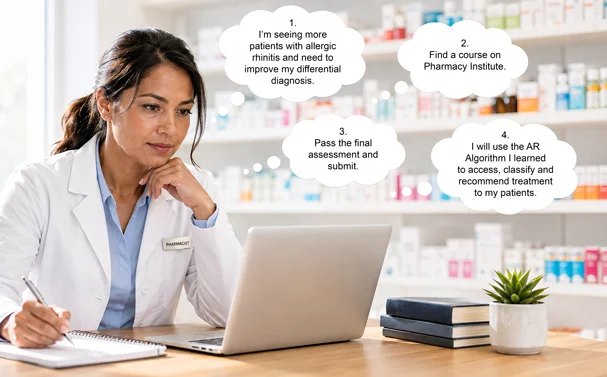
One of the most remarkable things about pharmacists is how effortlessly they appear to make complex clinical decisions. A patient describes a symptom, asks for advice, and within moments receives a recommendation. To most people, it seems straightforward. In reality, that recommendation often reflects years of education, professional judgement, and continual learning.
Every recommendation begins long before the patient arrives
Behind every pharmacist recommendation is a university degree, supervised practical training and thousands of previous patient interactions. Every consultation adds another layer of experience, enabling pharmacists to recognise patterns, identify risks and tailor recommendations to the patient in front of them.
“When a pharmacist makes a treatment recommendation, patients don’t realise just how much clinical reasoning is behind it. Every recommendation draws on years of accumulated knowledge and experience,” says Michael Gullan, CEO of Pharmacy Institute, an accredited e-learning provider for 13200+ pharmacy professionals in South Africa.
More than matching symptoms to medicines
A pharmacist rarely thinks about treatment in isolation. Within seconds, they consider the patient’s age, existing medical conditions, current medicines, allergies, pregnancy status, symptom duration, and whether the presentation suggests a more serious condition requiring referral.1-5
This process is known as clinical reasoning. It combines scientific knowledge with experience and professional judgement to determine the safest, most appropriate course of action for each patient.
Experience changes what pharmacists notice
An experienced pilot notices subtle changes in the weather before passengers realise anything has changed. Likewise, pharmacists develop similar pattern recognition. “Their education and thousands of patient consultations provide the foundation for recognising when two people with apparently similar symptoms may require completely different treatment recommendations,” adds Gullan.
Knowledge has a shelf life
Healthcare evolves continuously. New medicines are introduced, safety information changes, clinical guidelines are updated, and new evidence reshapes best practice. Professional learning therefore continues throughout a pharmacist’s career, ensuring the advice and treatment recommendations they offer patients are aligned with current evidence rather than outdated knowledge.3-6 “Learning doesn’t end at graduation,” says Gullan. “It continues throughout a pharmacist’s career because patients deserve advice based on today’s evidence, not yesterday’s.”
Commitment to continuous learning
The South African Pharmacy Council (SAPC) requires all pharmacists to complete annual Continuing Professional Development (CPD).7 Pharmacists identify their personal learning needs and acquire the knowledge needed to close those gaps. “Pharmacy Institute was developed with this process in mind,” added Gullan. “Pharmacists select their courses, complete them online, and pass the final assessment. At the end of the year, they simply download all their certificates and submit them online to SAPC at the end of the CPD cycle.”
Improving patient care
The emphasis is not on attending courses for attendance’s sake. Pharmacists are expected to identify genuine gaps in their knowledge based on their patients and practice. They then complete the courses that addresses those gaps and demonstrate how it has influenced their practice. The aim is to support ongoing competence and better patient care. “Continuing professional development isn’t simply about attending a course or earning a certificate. A pharmacist’s ongoing learning impacts patient outcomes and therefore should be informed by current evidence,” concluded Gullan.
Trust built on knowledge
For millions of South Africans, pharmacists are among the most accessible healthcare professionals. Every recommendation they make represents far more than a product choice. It reflects clinical judgement, professional responsibility, and an ongoing commitment to keeping knowledge up to date.
The recommendation may only take a few seconds. The expertise behind it has taken years to build.

