



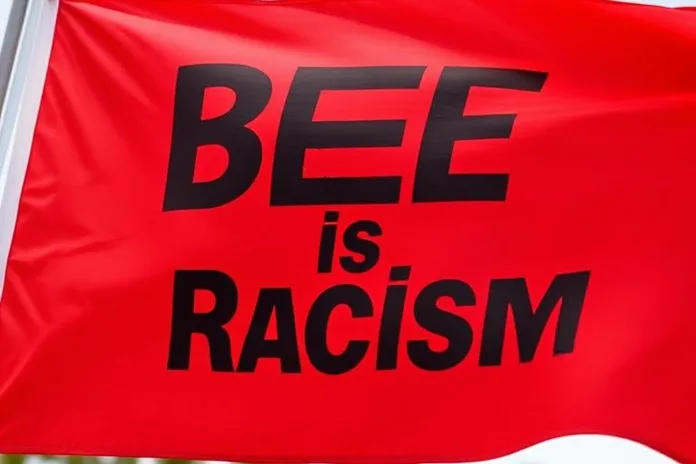
A significant political clash has emerged within South Africa’s Government of National Unity (GNU) following the Democratic Alliance’s (DA) introduction of new legislation aimed at repealing Broad-Based Black Economic Empowerment (B-BBEE) from government procurement.
The DA has launched the “Economic Inclusion for All Bill,” which it states is intended to remove B-BBEE criteria from state procurement processes and instead give preference to companies that make what it defines as valuable contributions to society.
In a televised interview, African National Congress (ANC) national spokesperson Mahlengi Bhengu strongly defended the policy, expressing her party’s skepticism of the DA’s move.
“I find it interesting that of all pieces of legislation that were passed by Parliament, its GNU partner, the DA, finds problems about the ones that push for a redress,” Bhengu stated.
She pushed back against criticisms that B-BBEE has only benefited a small elite, arguing that the policy’s objectives were never to be a “silver bullet” but to work in tandem with other government programs to address inequality. Bhengu pointed to employee share ownership programs (ESOPs) and union equity holdings as examples of broader benefits.
“The purposes and objectives of tripleB were never about it being a silver bullet,” she said. “It has a place in the transformation of our society. It has a place in redressing past imbalances.”
When confronted with the perception that B-BBEE has become directly linked to corruption, Bhengu acknowledged the problem but argued it should not lead to discarding the entire policy.
“It has been corrupted by a few,” Bhengu conceded. “It doesn’t justify not actually acknowledging a lot of the benefits of TripleB.” She called for a stronger focus on prosecuting corruption, stating that the fight against graft “mustn’t be a fight that dismisses the significance and the contribution of tripleB.”
The ANC spokesperson also conceded that her party is suffering from a “believability problem” and a “credibility crisis” with the South African public, which makes it difficult for citizens to trust their assurances on the matter.
Regarding internal party matters, Bhengu confirmed that ANC National Executive Committee member Fikile Mbalula undertook a recent trip to Libya, clarifying it was “official business of the ANC” funded by party resources, not the state. She defended the party’s right to oversee its deployees in metropolitan municipalities like Johannesburg, where the controversial former municipal manager Floyd Brink is a subject of discussion, but stated there was “no decision by the ANC to ever interfere on matters that would amount to a conflation of party and state.”
On the future of B-BBEE, Bhengu stated the ANC’s official line is to keep the policy, and they are prepared to rebut the DA’s “wrong narrative” in Parliament. While not ruling out future engagement with the DA’s bill, she emphasized, “At this point we’re not there.”
The public disagreement sets the stage for a contentious parliamentary debate, highlighting a fundamental policy rift between the two major partners in the GNU.

