



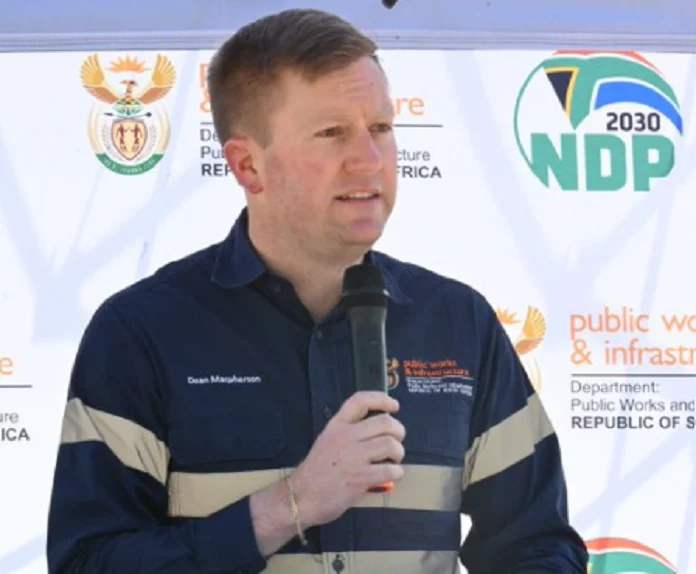
KOUGA — A landmark Ongegunde Vryheid conservation deal has been finalized to protect approximately 235 hectares of ecologically sensitive State-owned land near Cape St Francis. Announced on Friday by Public Works and Infrastructure Minister Dean Macpherson and Kouga Local Municipality Executive Mayor Hattingh Bornman, the first-of-its-kind agreement breaks a ten-year administrative deadlock while balancing critical nature preservation with the region’s future housing needs.
The resolution follows a complex process that originated in 2015 when the Kouga Local Municipality initially sought to utilize the State-owned property for municipal and residential development. However, subsequent environmental assessments revealed that significant portions of the land were unsuitable for housing. To resolve this, Minister Macpherson directed a definitive solution in October 2025, leading to a revised strategy that separates the conservation zones from areas earmarked for future human settlements. Following legal reviews, final approval for this dual-track approach was granted on September 29, 2026.
Under the new framework, the 235 hectares will be formally protected as a nature reserve in accordance with the National Environmental Management: Protected Areas Act. The Kouga municipality will assume ongoing management responsibilities at zero operational cost to the national department.
The protected area encompasses highly sensitive ecosystems, including vital coastal dune systems that ensure beach stability, crucial wetlands that regulate water flows, and the critically endangered St Francis Strandveld vegetation. It also provides a habitat for threatened plant species, diverse wildlife, and significant archaeological heritage that will be preserved for future generations. Furthermore, the arrangement safeguards the natural assets that underpin the region’s nature-based tourism economy.
Highlighting the strategic importance of the agreement, Minister Macpherson emphasized the necessity of unlocking the value of idle State assets.
“This is an example of what can be achieved when government takes the initiative to overcome administrative obstacles and find practical solutions that put public assets to work for the benefit of communities,” Macpherson stated. He noted that government land must not remain trapped in an impasse when it can deliver meaningful public value, whether through economic development or protecting environmentally sensitive areas. “At Ongegunde Vryheid, we are doing precisely that.”
Executive Mayor Hattingh Bornman echoed the sentiment, noting that the partnership secures the region’s unique natural heritage without compromising future urban planning.
“Ongegunde Vryheid is an environmental asset that deserves to be protected and managed responsibly, not left vulnerable to degradation because of administrative delays,” Bornman explained. He added that the agreement preserves the natural environment that drives the local tourism economy while demonstrating that conservation and development are not mutually exclusive when government collaborates effectively to find sustainable solutions.
The Department of Public Works and Infrastructure anticipates that the arrangement will yield significant positive impacts for local conservation efforts, the tourism sector, and the broader community by ensuring the public asset is protected from environmental degradation.
Meanwhile, the separate administrative process concerning the remaining land designated for future human settlements will continue to advance through the appropriate governmental channels.

