



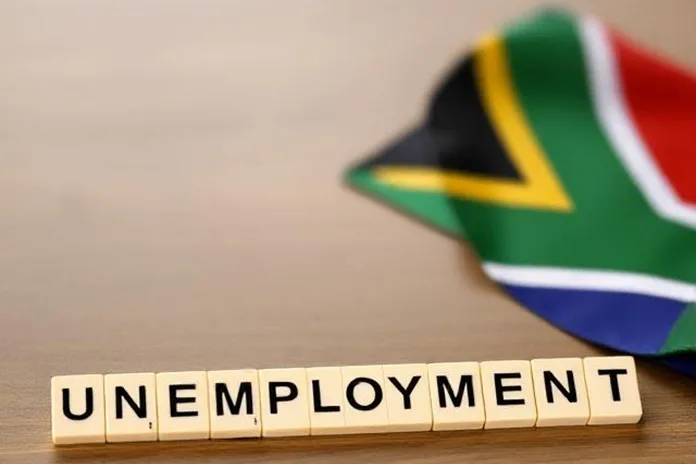
South Africa’s unemployment rate climbed to 32.7% in the first quarter of 2026, up from 31.4% in the final quarter of 2025, according to new data released on Wednesday. More than 300,000 South Africans lost their jobs in the first three months of the year as a strained economy continued to erode work opportunities.
The largest job losses were recorded in community and social services, which shed 206,000 positions, followed by construction (110,000), transport (30,000), and private households (28,000). Employment increased in manufacturing (38,000 jobs), mining (32,000), and agriculture (10,000).
Youth unemployment—among those aged 15 to 34—rose by two percentage points to 45.8%.
Speaking on the latest figures, Sifiso Skenjana, managing director and economist at ESG Analytics, said the data reflects a long-standing structural mismatch between the skills of available workers and the needs of the economy. He noted that 91% of unemployed South Africans have a matric or lower level of education, even as the services sector contributes about 24% of GDP.
“What needs to particularly take place now is that we need to have an investment drive that looks at specifically supporting growth within the primary sector,” Skenjana said. “We’ve got to look at reinvigorating that sector. At some point agriculture did employ up to 1.6 million people, and now there are about 960,000 employed in the sector. That is a sector that can employ that type of skill set.”
When asked whether private sector caution—citing high oil prices and geopolitical risks—was a valid reason for holding back investment, Skenjana rejected the notion as a “lazy excuse.” He pointed to high levels of industry concentration in South Africa, which he said suppresses innovation, and noted that companies have been shifting workers from full-time to part-time employment over several years. He added that South African corporates are holding cash balances north of one trillion rands.
“Corporates have a meaningful role to play to use supply chains to support employment creation through small and medium enterprises, to deepen investment in innovation and R&D,” he said.
On graduate unemployment, Skenjana clarified that the rate for university graduates remains just above 10%, relatively low compared to the national average. The real challenge, he said, is absorbing the hundreds of thousands of matriculants who do not go on to university. Out of 700,000 matriculants last year, only about 23,000 are expected to graduate from university within three years.
He cited Germany as a useful case study, noting that in 1966 Germany faced a similar skills mismatch. The country moved its education cluster into its economic planning cluster, and companies partnered with learning institutions to write curricula for the vocational skills they needed. As a result, close to 60% of the German workforce came through vocational learning, with an absorption rate of roughly 68%.
“We really need to start meaningfully think about the absorption of the guys who don’t go through the traditional university structures,” Skenjana said.
Meanwhile, rising global oil prices linked to tensions involving Iran are pushing inflation up again, according to the Bureau for Economic Research. Although the government’s temporary fuel levy relief has softened the impact, inflation is still expected to rise to around 4% in 2026, with some months possibly nearing 5%. The South African Reserve Bank may face pressure to consider another interest rate hike.

