



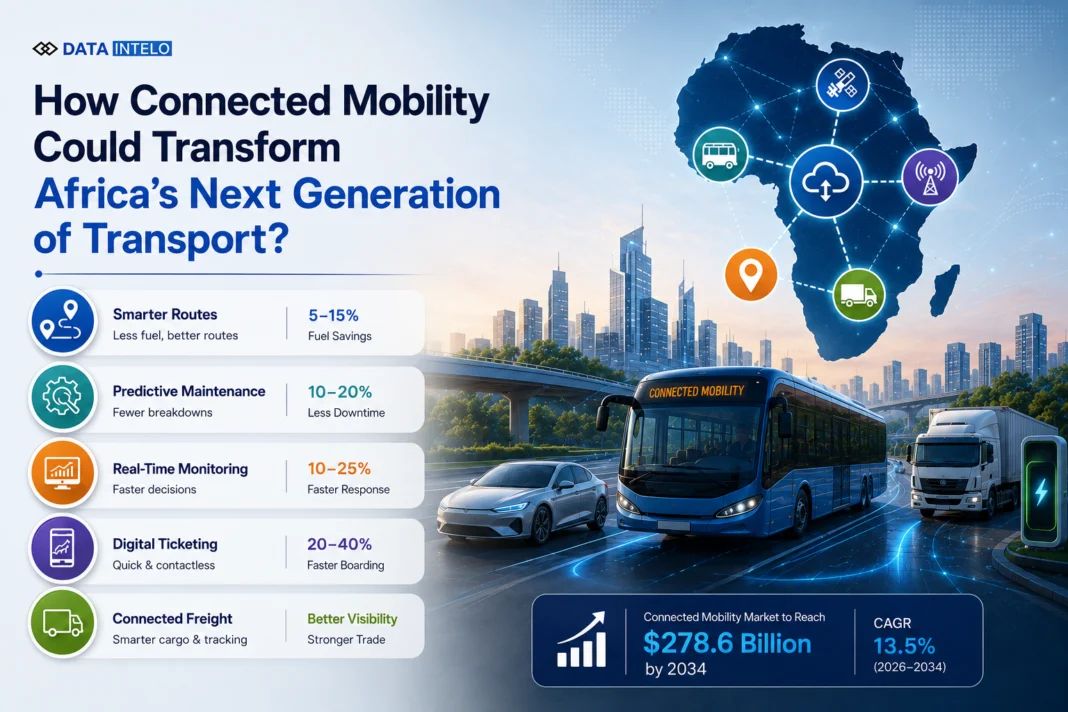
The transport industry in Africa is undergoing changes towards interconnected design due to urbanization in cities, increases in freight volume, and development of digital infrastructure.
Connected mobility encompasses linkages of vehicles to roads, people, traffic and logistics using technology like sensors, GPS, mobile communication, cloud and artificial intelligence. According to plans, Africa is expected to have about 2.5 billion population by 2050 leading to increased demand for reliable transport services.
Urban Expansion is Transforming Mobility
Estimates indicate that by 2050, the proportion of Africa’s population who reside in cities will reach about 60%, from 44% as in 2020. The result will be a greater strain on traffic systems, public transport and informal means of transport.
Urban mobility capabilities will help the cities relieve some of the pressure, as cities will be able to know the traffic conditions in real time, track vehicles, plan the routes digitally, and use smart traffic lights.
Connected Vehicles Could Improve Fleet Efficiency
Telematics is the term used for systems that collect data about speed, fuel consumption, braking performance, engine performance, and location of vehicle. The fleet of 1,000 vehicles can produce several hundred data points every hour.
Research into fleet operations suggests that by combining telematics monitoring with driver training and route optimisation processes, fuel consumption reduction of 5% to 15% can be reached. Additionally, predictive maintenance helps to reduce unforeseen vehicle downtime by detecting the technical problem before malfunction happens.
| Connected Mobility Application | Potential Benefit |
| GPS and route optimisation | 5–15% lower fuel use |
| Predictive maintenance | 10–20% less unplanned downtime |
| Real-time monitoring | 10–25% faster response |
| Digital ticketing | 20–40% faster boarding |
As per a report, the worldwide connected mobility industry had a net worth of $89.4 billion in 2025 and is estimated to attain a value of $278.6 billion in the year 2034, showing a compound annual growth rate (CAGR) of 13.5% between the years 2026 and 2034.
The growth in the market results from the increasing installation of 5G connectivity infrastructure, growing popularity of electric vehicles across the world, and multiple regulations regarding advanced vehicle safety mechanisms.
Public Transportation May Acquire Greater Predictability
Transportation implies that public transport is vital for getting around the African continent and within the cities. South Africa has millions of trips carried out per day by buses, trains, taxis, and minibuses. Integrated systems would facilitate the use of location, schedule, demand, and payment information of the public transport system for the purpose of coordination.
Access to real-time arrival data decreases uncertainty, while electronic ticketing speeds up the boarding process. For instance, a bus can take on board 60 passengers and if electronic processing saves 10 seconds per passenger, the boarding time itself is nearly halved.
The Importance of Freight Connectivity in Trade
Road Freight to African trade is crucial when products are needed to travel long distances in the supply chain from production facilities to ports, customs, and cities. The African Continental Free Trade Area functions in 55 nations.
United transport systems make it possible to monitor the fleet, analyze engine performances, and receive timely information on customs issues. Thermal sensors are necessary for the transportation of food and medicines because their operation requires temperature control within the range of 2 to 8 degrees Celsius.
Connected Mobility Ensures Road Safety
Connected mobility helps to promote road safety through tracking the speed of vehicles, braking, condition of routes, and performance of vehicles. A fleet of 500 vehicles makes it possible to create thousands of driving events daily that provide operators with data regarding risky driving habits and condition of vehicles.
Important use cases of connected mobility include:
- Speed monitoring: Monitor speeding incidents while using 500 vehicles.
- Driver monitoring: Record hard stops and cases of acceleration.
- Vehicle monitoring: Help monitor mechanical problems.
- Alerts: Provide timely emergency response.
In case of transport networks in Africa, this data can help ensure safer driving, improved fleet management, and efficient road planning.
Electric Mobility Introduces a New Level of Information
To operate buses, taxis, and other delivery services using electricity it is important to possess all the information about battery condition, charging processes, energy consumption, and distance covered. If a company has 500 vehicles, it means many hundreds of charging operations per day.
Intelligent charging allows us to redistribute energy demand and to combine route data with vehicle autonomy potential. Initiatives directed toward EV infrastructure, clean mobility, and two- and three-wheelers are making their contribution to a more sustainable electric mobility transition in Africa.
Improving Alongside Technology?
The success of connected mobility relies not only on the software but also on certain conditions that influence the effectiveness of digital transport systems as follows:
- Reliable mobile and broadband networks along transport corridors.
- Reasonably priced sensors and connectivity plans and digital payment systems.
- Data standards that enable various platforms to communicate.
- Effective cybersecurity and privacy measures.
- Trained specialists that can operate the connected infrastructure.
A Future of Better Mobility
The next stage of transport in Africa is going to involve several technologies coming together. AI is likely to offer answers to traffic flow problems, IoT devices will collate traffic infrastructure and vehicles data, while cloud technologies will facilitate processing and transmission of information.
If connected devices could save just 10% of urban trip time, that would mean that every day each African city with 1 million commuters would save hundreds of thousands of hours of travel. But the real indicator of progress will be the results. This will include safe roads, shorter waiting times, dependable transport system, and smooth goods movement.
Connected mobility means that it is less about one technology and more about a new approach to transport management. Diverse infrastructure of Africa makes it difficult to realize the idea, but better connectivity, perfect data systems, and timely investments will create efficient transport systems for the growth of the continent.
Author Bio –
Ashish Kolte is a Marketing Manager at Dataintelo with expertise in marketing, market intelligence, and business strategy. He combines marketing insights with industry research to analyze market trends, identify growth opportunities, and provide data-driven perspectives on emerging industries and global business developments.
Company Name – Dataintelo

