



- South African authorities arrested a 28-year-old man with 150 venomous scorpions in his bag at Cape Town airport.
- The intelligence-led operation followed a tip-off on his movements. He allegedly smuggled the scorpions from the wild and faces wildlife trafficking charges. The investigation is ongoing.
- Scorpion venom is highly prized for use in biomedical research and the beauty industry. They are also kept as pets by collectors of rare and venomous arachnids.
- The arrest and seizure highlight the growing trade in scorpions and spiders, as conservationists call for increased protections for these arachnids under an international wildlife trade treaty, CITES.
South African police arrested a 28-year-old man at Cape Town International Airport on June 12, 2026. Inside his luggage, tucked between his clothing, authorities discovered 150 live venomous scorpions. Each one was individually wrapped in a clear plastic bag, like candies at a supermarket
It’s not known where the alleged smuggler intended to take the scorpions or for what purpose.
An intelligence-led operation targeted the suspect: Authorities acted on a tip about a man in possession of wildlife. The bust was conducted by the Kuilsriver Stock Theft and Endangered Species Unit, a special police force, in collaboration with CapeNature, a government agency tasked with environmental protection in the Western Cape.
Police spokesperson Sergeant Wesley Twigg told local media that he was arrested on suspicion of being in “possession of a wild animal under the Nature and Environmental Ordinance Act.” An investigation into the case is ongoing. The commercial value of the seized scorpions is yet to be determined, authorities said.
The rescued scorpions are being cared for by the Cape of Good Hope SPCA. In a social media statement, the animal rescue organization said they are ensuring the arachnids receive proper care, and they will try to return them “to their place of origin where possible.”
Scorpion trade, like other wildlife, is booming
The planet is home to more than 2,900 scorpion species; only 25-30 have venom, a cocktail of neurotoxins they use to sting and numb their prey, which can be lethal to humans. These arachnids are important to the ecosystems they inhabit, acting as both predators and prey. Burrowing scorpions also dig up soil, aerating it in the process.
Southern Africa has about 150 scorpion species. Two of them are responsible for four to five human deaths each year.
Scorpion venom is a prized commodity, fetching as much as $10 million a liter ($37 million per gallon) from certain species. It’s coveted in biomedical research as a potential cure for cancer and other ailments, and is also used in cosmetics to reduce fine lines and wrinkles on the skin, just like Botox. As a result, the trade in arachnids is booming. To meet the demand, scorpion farmers now raise thousands of these arachnids to milk the venom.

Scorpions have also become a sought-after exotic pet, and more than 350 species are recorded in trade. Some 863 million arachnids — scorpions and spiders — were legally brought into the U.S. between 2000 and 2022, according to a 2025 study published in the Proceedings of the National Academy of Sciences by Alice Hughes and her colleagues, . Many were either captive-bred or pulled from the wild, captured as eggs or juveniles and raised in captivity.
But only 1% of all scorpion species have been assessed by the IUCN, the global wildlife conservation authority. This means that there’s little knowledge of their numbers, conservation status, or the threats they face in the wild. Commerce is regulated for only five species under a global wildlife trade treaty, CITES.
“Invertebrates are singularly under-protected in trade. A very small number of arachnids and butterflies are protected under CITES,” said Hughes, who is now at the University of Melbourne. “Whilst there are many thousands of species in trade, establishing exactly how many is very challenging due to a lack of monitoring.”
As scorpions continue to lose habitat to agriculture, mining and human settlements, this massive trade concerns experts. In a 2025 letter published in the journal Science, researchers wrote that their extinction “would erode ecosystem integrity and remove potential sources of human advancement.” They also urged IUCN to assess species most at risk for its Red List of Endangered Species and for CITES to regulate international trade found to be in need of protection, and include them in conservation management plans.
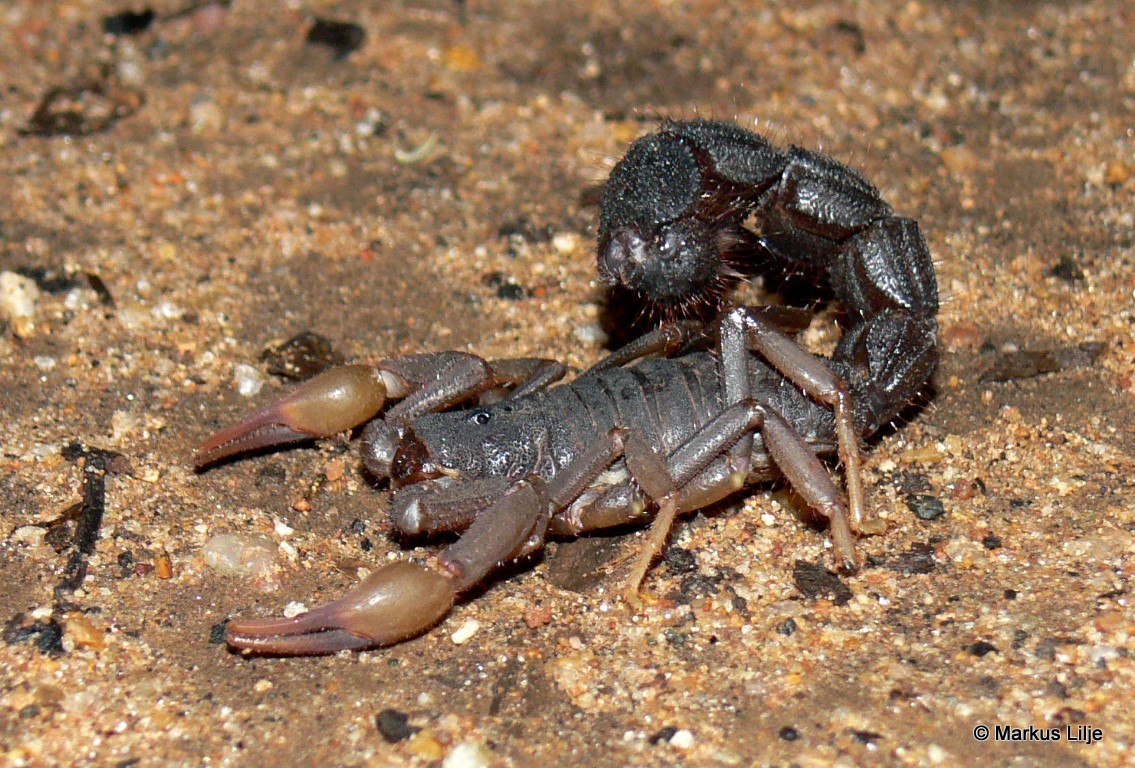
Banner image: The transvaal thicktail scorpion (Parabuthus transvaalicus) is one of two venomous scorpion species in South Africa whose stings could be fatal to humans. Image © markus lilje via iNaturalist (CC BY-NC-ND 4.0).
Spoorthy Raman is a staff writer at Mongabay, covering all things wild with a special focus on lesser-known wildlife, the wildlife trade, and environmental crime.
Australian authorities seize 100,000 live cockroaches in crackdown on exotic insect trade
Citations:
Marshall, B. M., Alamshah, A. L., Cardoso, P., Cassey, P., Chekunov, S., Eskew, E. A., … Hughes, A. C. (2025b). The magnitude of legal wildlife trade and implications for species survival. Proceedings of the National Academy of Sciences, 122(2), e2410774121. doi:10.1073/pnas.2410774121
Blasco-Aróstegui, J., Moreno-González, J. A., Loria, S. F., Carvalho, L. S., Bird, T. L., Nguyen, A. D., … Prendini, L. (2025). Include scorpions in global conservation plans. Science, 389(6765), 1099–1100. doi:10.1126/science.adz4176
FEEDBACK: Use this form to send a message to the author of this post. If you want to post a public comment, you can do that at the bottom of the page.
Credits

This story first appeared on Mongabay
This article is licensed under a Creative Commons Attribution-NoDerivatives 4.0 International License.
You may republish this article, so long as you credit the authors and Mongabay, and do not change the text. Please include a link back to the original article.

