



- A new regional assessment has identified 122 important shark and ray areas (ISRAs) across Asia, spanning more than 1 million square kilometers (386,102 square miles) and supporting 121 species, many of them threatened with extinction.
- Despite their ecological importance, only 5.4% of these habitats overlap with existing marine protected areas with only 2.8% falling within fully protected no-take zones, highlighting major conservation gaps.
- Sri Lanka has five identified ISRAs, home to nine species with eight of them threatened with extinction, but only Pigeon Island in the island’s east is formally protected, with most areas still functioning as active fishing grounds.
- The new study underscores an urgent need to move from mapping to management, using ISRAs to guide marine spatial planning, fisheries regulation and habitat protection ahead of global 30×30 ocean targets.
COLOMBO — The majority of 122 marine areas identified across Asia as critical for the survival of sharks, rays and chimaeras remain largely unprotected despite supporting some of the world’s most threatened marine species, according to a new study.
Published in Biodiversity and Conservation, the study assessed the network of important shark and ray areas (ISRAs) across 19 Asian countries and territories and found that only 5.4% of their total area overlaps with recognized marine protected areas (MPAs). Just 2.8% falls within fully protected no-take zones where extractive activities are strictly prohibited.
Together, these ISRAs cover more than 1 million square kilometers (approximately 386,102 square miles) of ocean and support sharks, rays and chimaeras, also known by the umbrella term elasmobranchs. Nearly three-quarters of these species are listed as threatened with extinction on the IUCN red list, highlighting the urgency of conserving these habitats, said study lead author Adriana Gonzalez-Pestana, a Ph.D. candidate at Charles Darwin University (CDU) in Australia and member of the IUCN SSC Shark Specialist Group ISRA project. IUCN is the global wildlife conservation authority.

The ISRA initiative identifies habitats essential for sharks, rays and chimaeras based on key life-history functions such as breeding, nursery grounds, feeding aggregations and migration routes. Unlike MPAs, ISRAs have no legal status, but instead serve as a scientific tool to guide governments, conservation agencies and fisheries managers in prioritizing protection measures, Gonzalez-Pestana told Mongabay.
The Asian ISRAs were found to support around one-third of all shark and ray species globally, underscoring the region’s global importance. “However, Asia is also the epicenter of shark and ray declines, driven by overfishing, habitat degradation and coastal development with nearly half of all the species assessed in the region now at risk of extinction,” she said.
Since its launch in 2022, the ISRA program has identified more than 990 ISRAs worldwide across 10 ocean regions. An assessment in the Western Indian Ocean revealed weak protection, with only 7.1% of ISRAs falling within MPAs and just 1.2 % being fully protected areas where fishing is prohibited.
Sri Lanka case study
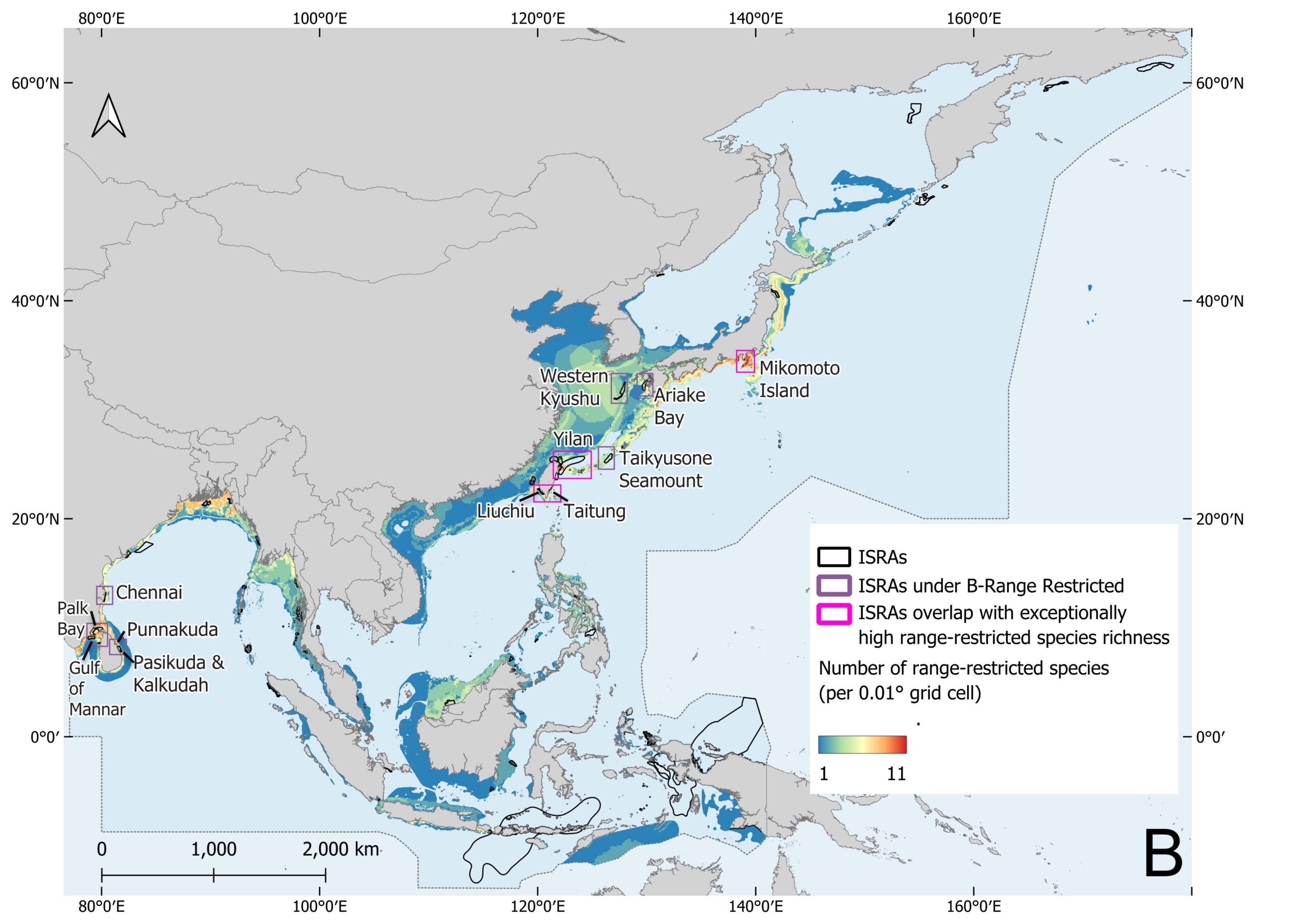
According to the new study, only a few ISRAs in Asia coincide with areas considered exceptionally rich in species and with limited geographic ranges. Because these range-restricted species – or home to species with a geographically restricted area of distribution –occur in relatively few places and habitats they depend on are highly irreplaceable, they are particularly susceptive to extinction, Gonzalez-Pestana said.

Sri Lanka is one such location: Four out of its five ISRAs support range-restricted species. In northern Sri Lanka, the Palk Bay ISRA is shared with India and supports threatened species, such as the shorttail whipray (Maculabatis bineeshi); range-restricted species, like the sharpnose guitarfish (Glaucostegus granulatus); and reproductive areas for the grey sharpnose shark (Rhizoprionodon oligolinx).
In north-western Sri Lanka, the Baththalangunduwa ISRA is an important reproductive area for the critically endangered winghead shark (Eusphyra blochii). In eastern Sri Lanka, the Pigeon Island ISRA supports aggregations of the blacktip reef shark (Carcharhinus melanopterus), while the eastern Punnakuda and Pasikuda & Kalkudah ISRAs support threatened and range-restricted species, such as the Indian swellshark (Cephaloscyllium silasi) and stripenose guitarfish (Acroteriobatus variegatus).
These areas highlight Sri Lanka’s importance as a hotspot for shark and ray biodiversity in the northern Indian Ocean. However, only the Pigeon Island ISRA, also declared as a marine national park falls within a formally protected marine area, said Daniel Fernando, co-founder and director of the fisheries and policy program at Blue Resources Trust (BRT), a Sri Lankan conservation organization dedicated to protecting marine biodiversity through research, advocacy and community engagement.

Field researchers from BRT report frequent encounters with fisheries impacting these species. Gobiraj Ramajeyam, who conducts surveys in northern Sri Lanka, said critically endangered species such as the sharpnose guitarfish are often landed as bycatch or targeted catch in the Palk Bay region.
Similarly, BRT marine biologist Anusha Neranjan, who works in Baththalangunduwa, has observed juvenile winghead sharks entangled in gillnets, wide, vertical fishing nets, and other fishing gear. “It is heartbreaking to witness juvenile hammerhead sharks entangled in nets, some only a month or two old,” he said. There are instances when groups of these critically endangered sharks die after getting caught in fishing gear, Neranjan told Mongabay.

Fernando said that Baththalangunduwa ISRA is particularly significant, because it supports one of the two known populations of winghead sharks globally. Given the species’ vulnerability, such areas should be prioritized for national conservation and management, he said, adding that BRT has submitted the information on the ISRAs to the relevant state agencies and was hopeful these may contribute toward introducing new fisheries regulations.
Urge to spread protected areas
As a signatory to the U.N. Convention of Biological Diversity (CBD), Sri Lanka is committed to the global 30×30 target under the Kunming-Montreal Global Biodiversity Framework, which aims to protect 30% of the planet’s land and sea by 2030. Expanding and strengthening MPAs will be essential to meet this goal, said Sevvandi Jayakody, an echinoderm biologist at the Department of Aquaculture and Fisheries, Wayamba University of Sri Lanka.

The lack of comprehensive marine biodiversity data is a major challenge, especially beyond shallow coastal waters, Jayakody said. Fish landing-site data and fisheries-dependent information can, however, provide valuable insights for marine spatial planning, including ISRA identification, she told Mongabay.
“Many protected areas cover only fragments of larger ecosystems,” Jayakody said. “For example, the bar reef marine sanctuary protects only part of a much larger reef system. Conservation efforts should focus not only on declaring new areas but also on expanding and strengthening the existing ones.”
Citation:
Gonzalez-Pestana, A., Kyne, P. M., García-Rodríguez, E., Charles, R., Brito, V. B., Armstrong, A. O., … & Jabado, R. W. (2026). Critical habitats for sharks and rays in Asia remain largely unprotected. Biodiversity and Conservation, 35(7), 179. doi:10.1007/s10531-026-03356-2
Credits

This story first appeared on Mongabay
This article is licensed under a Creative Commons Attribution-NoDerivatives 4.0 International License.
You may republish this article, so long as you credit the authors and Mongabay, and do not change the text. Please include a link back to the original article.

