



SOUTH AFRICA — As the South Africa Local Government Elections 2026 approach, the Electoral Commission of South Africa (IEC) has issued comprehensive guidelines detailing polling schedules, strict identification requirements, and ballot procedures for participating citizens.
Polling Schedules and Registration Verification
The primary voting day is scheduled for 4 November 2026, with all voting stations operating from 7:00 a.m. to 9:00 p.m. For citizens requiring special voting accommodations, the IEC has designated 2 and 3 November 2026 as special voting days, with facilities open from 8:00 a.m. to 5:00 p.m.
Because municipal regulations require citizens to cast their ballots exclusively at their registered voting stations, the IEC strongly advises voters to verify their registration details prior to Election Day. Citizens can confirm their designated polling location and registration status through three official channels:
The official IEC portal at www.elections.org.za.
SMS service by sending a 13-digit ID number to 32810.
WhatsApp service by sending the word “Hi” to 060 088 0000.
Mandatory Identification Protocols
The Electoral Commission has enforced strict identification protocols for entry and voting. Accepted forms of identification are limited to a smart ID card, a green barcoded ID book, or a valid temporary identity certificate.
The IEC explicitly cautioned that alternative documents—including driver’s licenses, passports, student identification cards, and photocopies of ID documents—will not be accepted at voting stations under any circumstances.
Polling Station Procedures and Ballot Distribution
Upon arriving at a designated station, election officials will verify a voter’s identity and cross-reference their details against the official voters’ roll. To maintain electoral integrity and prevent duplicate voting, an official will mark the voter’s thumbnail with indelible ink before issuing the ballot papers.
The quantity and type of ballot papers issued depend entirely on the voter’s registered municipality:
Metropolitan Municipalities: Voters will receive two ballot papers. The first is a ward ballot to elect a local ward councillor, and the second is a proportional representation (PR) ballot to select a political party for the metropolitan council.
Local Municipalities: Voters will receive three ballot papers. These include the ward councillor ballot, a PR ballot for the local municipal council, and a district PR ballot to elect representation for the broader district municipal council.
Casting and Securing the Vote
The IEC mandates that all voting be conducted in the privacy of a designated voting booth. Voters must mark a single, clear “X” inside the designated box next to their chosen candidate or political party.
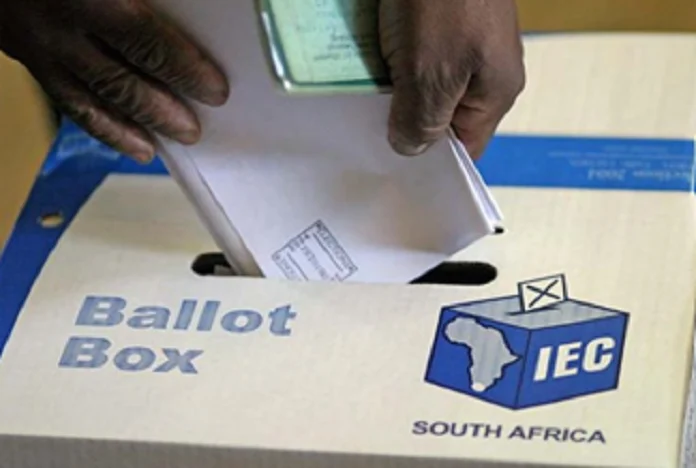
The Commission warns that writing a name, signing the document, or making any extraneous marks will render the ballot invalid. If a voter makes an error on their ballot paper, they must not deposit it into the ballot box. Instead, the spoiled ballot must be returned directly to the Presiding Officer, who will provide assistance and issue a replacement. Once completed correctly, voters must fold their ballot papers to ensure secrecy and deposit them into the ballot box under the direction of election officials.

